Quick answer
Construction ERP in Egypt helps contractors keep their Bill of Quantities (BOQ) aligned with real project costs. With Odoo ERP, each project is tracked through its own analytic account: BOQ quantities and rates become the budget, while purchase orders, vendor bills, site stock movements, timesheets, and expenses are recorded against the project. Managers then compare estimated and actual costs in real time and act on overruns before they reduce the project's margin.
Key takeaways
- A BOQ lists every item with its unit, quantity, unit rate, and total cost; it is the basis of estimating and cost control.
- Egyptian contractors face volatile material prices, so BOQ estimates must be checked against actual purchases continuously.
- Odoo links BOQ data with Purchase, Inventory, Project, Timesheets, and Accounting in one system.
- Analytic accounting and budgets give an estimated vs. actual view per project and per cost group.
- Standard Odoo covers cost tracking; a custom BOQ module adds item-level BOQ control when needed.
What is a construction BOQ and why is it important for Egyptian contractors?
A construction project needs more than drawings and deadlines. Contractors must know exactly what materials, labor, and equipment are required and what each stage will cost. A Bill of Quantities (BOQ) is the document that lists these resources with their estimated quantities and costs. It gives contractors, consultants, and project owners a common reference for estimating, tendering, and monitoring costs.
For Egyptian contractors, an accurate BOQ matters even more because material prices, supplier terms, and site conditions can change during a project. Connecting the BOQ to purchasing, inventory, and accounting in a construction ERP keeps the estimate useful from tender to handover.
What does a construction BOQ include?
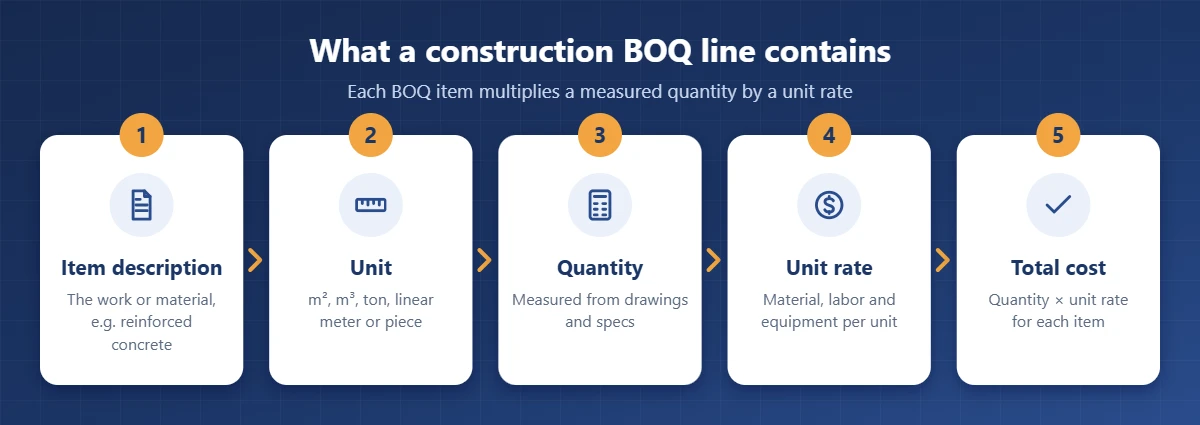
- Item description: a clear explanation of each activity or material.
- Unit of measurement: square meters, cubic meters, tons, linear meters, or pieces.
- Estimated quantity: the amount of work or material required.
- Unit rate: the cost to supply or complete one unit, including material, labor, and equipment.
- Total cost: quantity multiplied by unit rate for each item.
Why is a BOQ important for construction companies in Egypt?
- More accurate cost estimation: breaking the project into items reduces the risk of missing expenses.
- Better purchasing planning: known quantities let buyers plan orders and compare suppliers early.
- Budget control: the BOQ is the reference for spotting when actual costs exceed estimates.
- Transparency: contractors, consultants, and clients share one view of scope and cost.
- Easier monitoring: comparing BOQ items with actual expenses shows where costs are rising.
What is the difference between a BOQ and a construction budget?
The two are closely related but serve different purposes: the BOQ explains what the project requires, while the budget determines how much money is available to deliver it.
| Comparison | Bill of Quantities (BOQ) | Construction budget |
|---|---|---|
| Main purpose | Lists items, quantities, and unit rates | Defines total funds allocated to the project |
| Level of detail | Detailed breakdown of work and materials | Overall financial view by cost group |
| Main components | Materials, labor, equipment, quantities, unit prices | Estimated costs, allocated funds, contingencies |
| Main use | Estimating, tendering, quantity tracking | Financial planning and expense control |
| Updates | Changes with quantities or specifications (variations) | Revised for approved changes |
Common challenges in managing construction BOQs and costs in Egypt
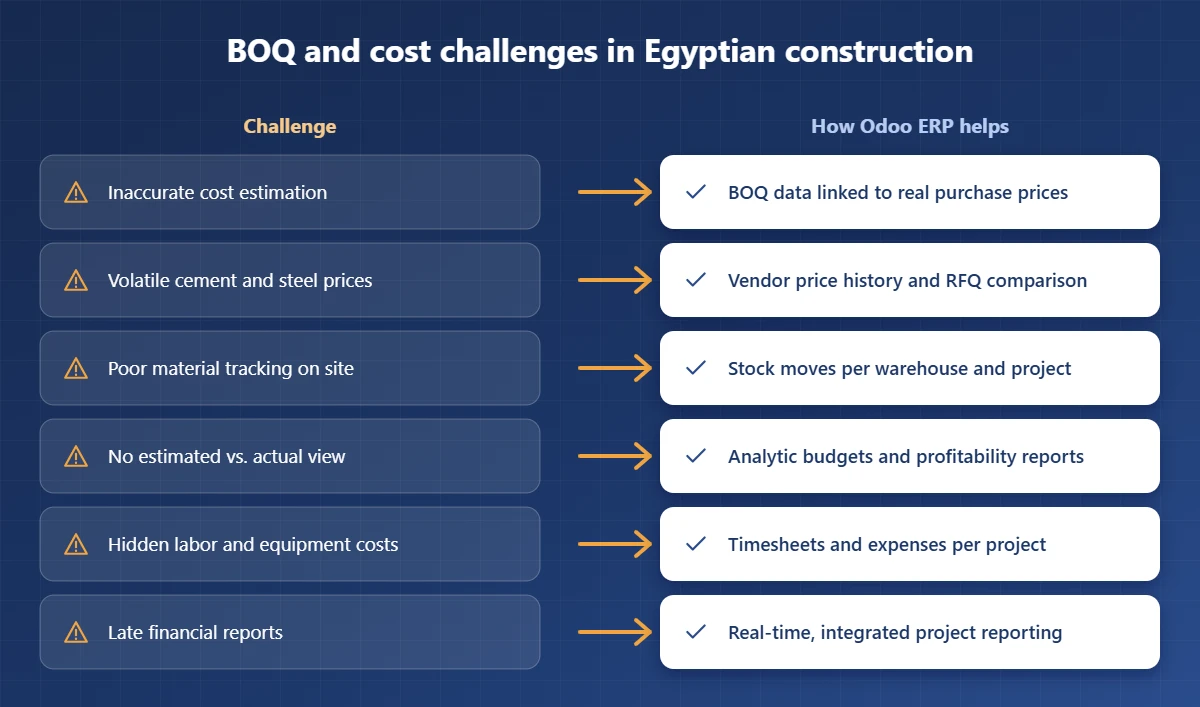
Even a small gap between estimated and actual costs can erase a project's profit, especially when several sites run at once. Most problems come from BOQ data that is not connected to what actually happens on site.
1. Inaccurate cost estimation
Missing quantities, calculation errors, or outdated prices produce unrealistic estimates. Linking BOQ items to recent purchase prices keeps estimates grounded in real costs.
2. Fluctuating material prices
Prices of cement, steel, electrical supplies, and finishing materials can change between tender and purchase, especially when buying in stages. Odoo keeps vendor price history and lets buyers compare RFQs, so the impact of price changes on each project is visible.
3. Poor material and inventory tracking
Without updated stock records, contractors face shortages, excess stock, delays, and unknown consumption per project. Odoo tracks deliveries to each site warehouse and material issued to each project.
4. No estimated vs. actual comparison
A BOQ is of little use if spending cannot be compared against it. Odoo analytic budgets compare planned and actual cost per project and cost group.
5. Unexpected labor and equipment expenses
Overtime, schedule changes, equipment rental, and maintenance raise costs. Recording timesheets and expenses against the project brings these costs into the same report.
6. Weak coordination between departments
Procurement, engineering, warehouse, site, and finance teams often work from separate files. One ERP gives every team the same, current information.
7. Delayed financial reporting
Monthly reports built from spreadsheets arrive too late to stop overspending. Integrated data makes up-to-date project reports available at any time.
| Common challenge | Impact on projects | How Odoo ERP helps |
|---|---|---|
| Inaccurate cost estimation | Unexpected expenses and budget gaps | Links BOQ and purchase cost data |
| Material price changes | Higher purchasing costs | Vendor price records and RFQ comparison |
| Poor inventory tracking | Shortages or excess stock | Stock moves and replenishment per site |
| Limited cost visibility | Overspending found too late | Analytic budgets per project |
| Labor and equipment costs | Unplanned cost increases | Timesheets and expenses per project |
| Poor coordination | Delays and inconsistent data | One shared system for all teams |
| Delayed reporting | Late response to budget problems | Real-time integrated reports |
How does Odoo ERP help manage construction BOQs?
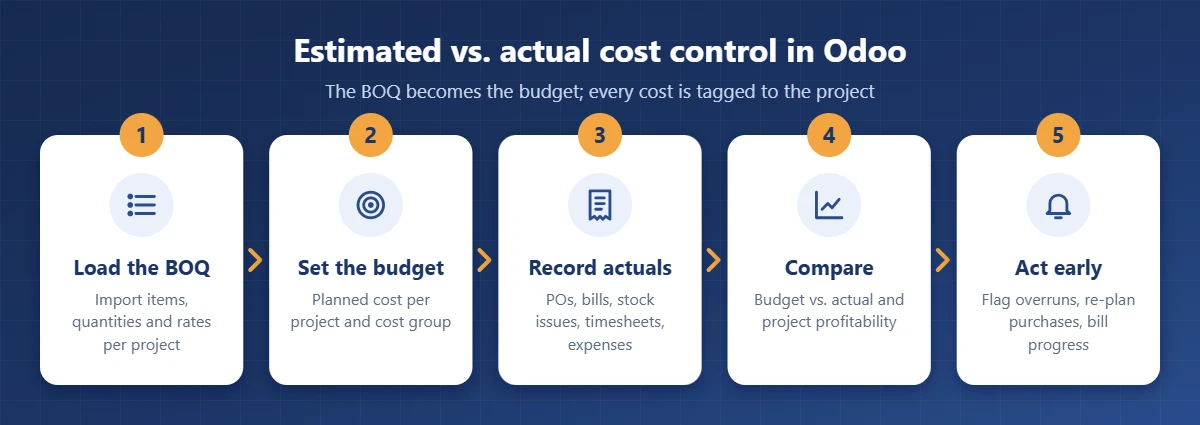
Odoo brings BOQ data, procurement, inventory, labor, and accounting into one platform, so cost control happens while the project runs, not after it ends.
1. Centralize BOQ data in one system
BOQ items, specifications, quantities, and unit rates are imported per project instead of living in separate spreadsheets. Engineers, buyers, and accountants work from the same records.
2. Turn the BOQ into a project budget
Each project is linked to an analytic account. BOQ totals are loaded as the budget by cost group, such as concrete, steel, finishing, labor, and subcontractors.
3. Connect BOQs with procurement and inventory
When the project needs cement, steel, electrical supplies, or finishing materials, buyers create purchase requests and RFQs, confirm purchase orders, and receive goods into the site warehouse, all tagged to the project.
4. Monitor actual costs against BOQ estimates
| BOQ component | How Odoo ERP tracks it |
|---|---|
| Material quantities | Stock moves and consumption per project |
| Material costs | Purchase prices and vendor bills on the project analytic account |
| Labor costs | Timesheets valued at each employee's hourly cost |
| Subcontractor costs | Service purchase orders and vendor bills |
| Other project expenses | Expenses and journal entries tagged to the project |
| Budget monitoring | Analytic budgets and project profitability reports |
5. Reduce manual errors and improve coordination
Buyers see material requirements, the warehouse sees incoming deliveries, and accounting follows supplier bills and payments, without re-entering data. Standard processes can be applied across all projects.
6. Bill clients by progress
Odoo Sales and Accounting support down payments and milestone-based invoicing, so progress claims can follow completed BOQ work. Egyptian Tax Authority e-invoicing is supported through Odoo's Egyptian localization.
Key features of Odoo ERP for construction cost management
| Odoo app | Main function | Cost management benefit |
|---|---|---|
| Project | Organizes phases, tasks, and progress | Cost and profitability view per project |
| Accounting | Analytic accounts, budgets, and financial records | Estimated vs. actual cost tracking |
| Purchase | RFQs, purchase orders, vendor prices | Controls material and subcontractor costs |
| Inventory | Site warehouses and stock movements | Reduces waste and excess stock |
| Timesheets | Employee working hours per project | Accurate labor cost monitoring |
| Expenses | Site and employee expenses | Captures small costs that add up |
| Sales | Quotations, contracts, progress invoices | Links revenue to project progress |
| Customization | BOQ module, dashboards, custom reports | Item-level BOQ cost analysis |
Project budgeting and cost tracking
Budgets by project and cost group, with actual purchases, labor, and expenses updated automatically, reveal unexpected increases in spending early.
Material and inventory cost management
Track cement, steel, electrical components, and finishing supplies from delivery to consumption, so essential materials are available without tying up cash in excess stock.
Purchase and supplier cost control
Supplier records, quotation comparison, purchase order tracking, and price trends support better purchasing decisions for every project.
Labor and subcontractor expense management
Timesheets assign working hours to projects, while subcontractor invoices and payments are recorded against the same project to show where the budget is being spent.
Real-time financial reporting
Managers can review actual vs. planned cost, material spend, outstanding supplier bills, and profitability across projects at any time.
Customization for different project types
Residential, commercial, infrastructure, and industrial projects follow different procedures. Custom development adds detailed BOQ breakdowns, project-specific budget reports, material costing workflows, subcontractor tracking, and financial dashboards.
How to implement Odoo for construction cost control
- Standardize your BOQ structure. Agree on item codes, units, and cost groups across projects.
- Set up projects and analytic accounts. One analytic account per project, with cost groups for reporting.
- Configure purchasing and site warehouses. Define who requests, approves, and receives materials at each site.
- Set employee cost rates. Make timesheets reflect real labor cost.
- Load BOQ budgets and build reports. Start with estimated vs. actual cost per project, then add dashboards.
- Train site and office teams. Data entered on time is what makes reports reliable.
Choosing the right construction ERP partner in Egypt
Successful implementation depends on understanding how contractors work. Ask potential partners:
- Have they implemented Odoo for construction or contracting companies?
- Can they model your BOQ structure and link it to purchasing and stock?
- Will they build estimated vs. actual cost reports per project?
- Do they handle Egyptian VAT and Egyptian Tax Authority e-invoicing?
- Do they provide training and long-term support?
Perfect Tech is an Odoo Gold Partner serving construction companies in Egypt and Saudi Arabia. We implement and customize Odoo ERP for construction, connecting BOQs, purchasing, site inventory, labor, and accounting. Learn more about our Odoo implementation in Egypt or browse our customer success stories.
Want to see estimated vs. actual cost on every project?
Share your BOQ structure with us, and we will show you how Odoo can connect it to purchasing, site stock, and accounting.
Talk to an Odoo expertFrequently asked questions
What is a BOQ in construction?
A Bill of Quantities (BOQ) is a document that lists every work item and material in a construction project with its unit of measurement, estimated quantity, unit rate, and total cost. Contractors, consultants, and owners use it for estimating, tendering, and cost control.
What is the difference between a BOQ and a construction budget?
The BOQ details what the project requires: items, quantities, and unit rates. The budget defines how much money is allocated and is used for financial planning and expense control. In Odoo, the BOQ values are usually loaded as the project budget.
Does Odoo ERP have a BOQ feature for construction?
Standard Odoo has no dedicated BOQ document, but BOQs can be managed by importing BOQ items into projects, sales quotations, or analytic budgets. Most contractors add a custom BOQ module that links each item to purchases, stock, and labor.
How does Odoo ERP help construction companies manage costs?
Each project gets an analytic account. Purchase orders, vendor bills, stock consumption, timesheets, and expenses are tagged to it, so Odoo shows actual cost per project and compares it with the budget in real time.
Can Odoo compare estimated and actual construction costs?
Yes. With analytic budgets and project profitability reports, Odoo compares planned BOQ costs with actual purchases, labor, and expenses, and highlights items that exceed their budget.
Can Odoo manage material costs on construction sites?
Yes. Odoo Purchase and Inventory track supplier prices, purchase orders, deliveries to each site warehouse, and material issued to each project, so material cost and remaining stock are always visible.
Does Odoo support labor and subcontractor cost tracking?
Yes. Timesheets record employee hours at their cost rate on each project, while subcontractor work is handled through purchase orders and vendor bills linked to the same project.
Is Odoo ERP suitable for construction companies in Egypt?
Yes. Odoo supports Egyptian accounting and VAT, and the Egyptian Tax Authority e-invoicing integration, in Arabic and English. It can be configured or customized for BOQs, progress billing, and multi-project cost control.
Why choose Perfect Tech for construction ERP in Egypt?
Perfect Tech is an Odoo Gold Partner in Egypt and Saudi Arabia. It implements and customizes Odoo for contractors, connecting BOQs, purchasing, site inventory, labor, and accounting, with reports that show estimated versus actual cost per project.