Procurement becomes harder to control as a business grows.
What begins with a few suppliers, purchase requests, and spreadsheets can quickly develop into a much more complex operation involving multiple warehouses, departments, branches, approval levels, vendor quotations, purchase orders, inventory receipts, and supplier invoices.
For Egyptian manufacturers, distributors, trading companies, construction businesses, and multi-branch organizations, the challenge is not simply buying products at the right price.
The larger challenge is creating visibility across the entire procurement cycle.
Management needs to know why a purchase is required, which supplier should fulfill it, what has already been ordered, what has actually arrived, what remains outstanding, and how every purchase affects inventory and financial obligations.
This is where Odoo procurement management in Egypt can create significant operational value.
By connecting purchasing with inventory, accounting, manufacturing, sales, and other business functions, Odoo ERP enables procurement to operate as part of one integrated business environment rather than as a collection of disconnected spreadsheets and documents.
For organizations that require a broader ERP architecture, Perfect Tech delivers Odoo Enterprise ERP solutions in Egypt designed around the company's actual operational, financial, warehouse, and organizational structure.
Why Procurement Becomes Difficult as Egyptian Businesses Grow
Purchasing can appear simple when a company is small.
A department asks for a product. Procurement contacts a supplier. A quotation is received. A purchase order is created. The warehouse receives the goods. Finance pays the invoice.
But every stage becomes more difficult at scale.
Several departments may request the same products. Different branches may purchase from different suppliers. A supplier may offer different prices based on volume. One warehouse may have excess stock while another is preparing a new purchase.
Finance may receive a vendor invoice before understanding whether the goods have actually been received, while manufacturing teams may require materials urgently even though procurement is still working from separate spreadsheets.
This creates a structural problem.
The company does not simply need a faster purchasing process.
It needs an integrated procurement environment where demand, supplier information, purchasing decisions, inventory movements, vendor bills, and financial data are connected.
That is the difference between digitizing purchase orders and building a real procurement management system.
What Is Odoo Procurement Management?
The Odoo Purchase application supports purchasing activities including Requests for Quotation, supplier information, purchase orders, vendor pricing, procurement controls, and purchasing analysis.
More importantly, purchasing can operate alongside Odoo Inventory, Accounting, Manufacturing, Sales, and other applications.
This integration allows a purchase to remain connected to the operational reason behind it.
A purchasing requirement may originate from low inventory levels, confirmed sales demand, manufacturing requirements, a project, maintenance activity, or another internal business need.
Instead of manually transferring information between departments, an integrated ERP maintains relationships between transactions throughout the workflow.
For Egyptian companies that have outgrown spreadsheets or disconnected accounting and inventory software, this model can provide substantially greater procurement visibility.
From Purchase Requests to Controlled Procurement Workflows
Effective procurement should begin before a purchase order is issued.
The first question should be:
Why does the company need to purchase this item?
The requirement could come from inventory replenishment, production demand, customer orders, project requirements, maintenance activity, or an internal department.
Once the requirement becomes visible within ERP, the organization can design an appropriate procurement workflow around it.
Different businesses require different levels of control.
A distributor may need purchasing decisions connected closely to stock availability and expected sales.
A manufacturer may require raw-material procurement linked to production requirements.
A construction business may need purchases associated with particular projects or cost centers.
A multi-branch company may require centralized procurement while allowing purchasing activities across several locations.
This is why ERP implementation should not begin by simply activating software modules.
The workflow needs to reflect how the organization actually operates.
Perfect Tech's Enterprise ERP solutions in Egypt are built around this principle: mapping business operations and configuring Odoo around entities, branches, warehouses, financial structures, operational workflows, and approval requirements.
Manage Requests for Quotation More Efficiently
Requests for Quotation, or RFQs, are a fundamental part of procurement.
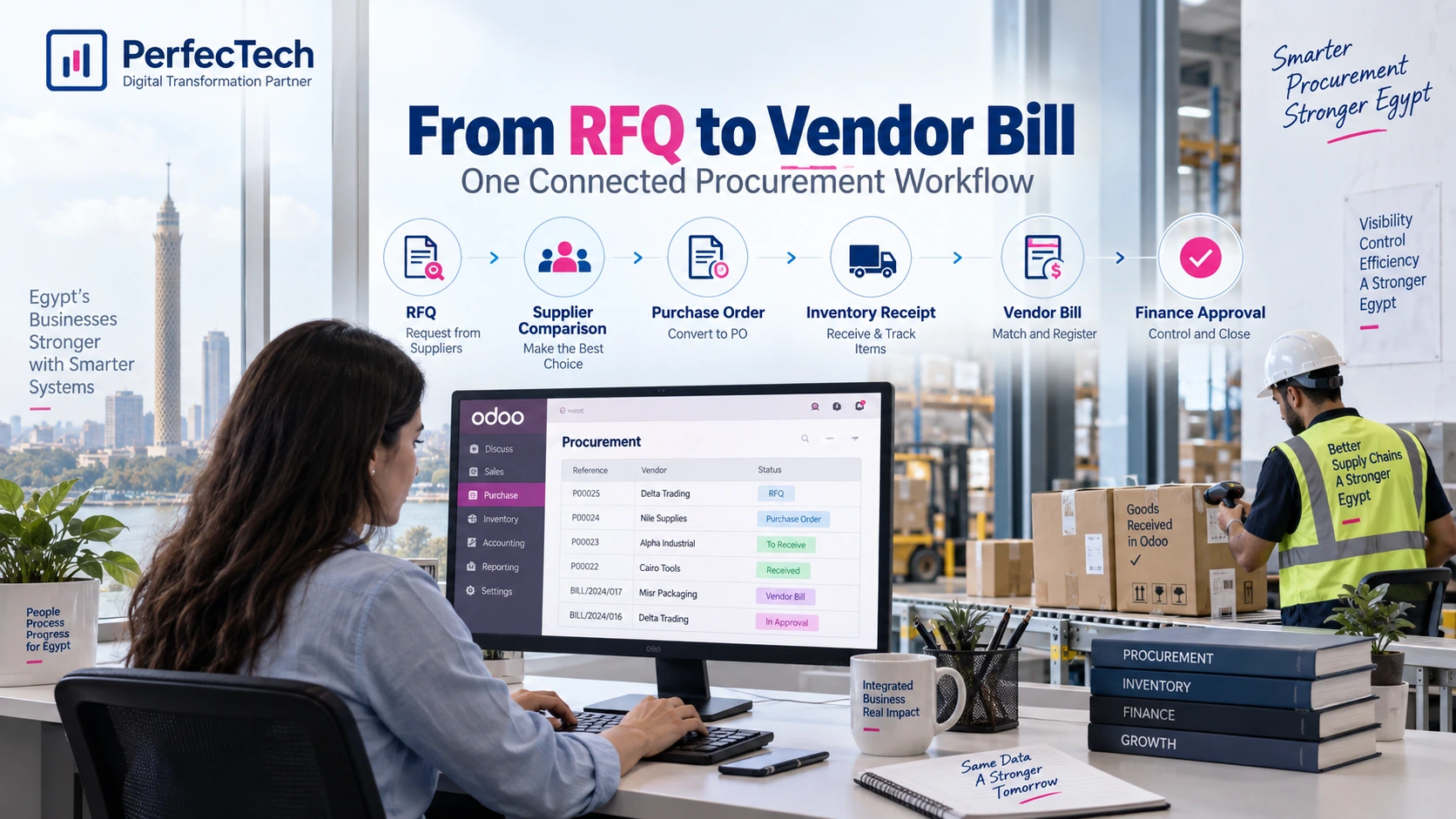
A procurement team may need to contact several suppliers, compare commercial conditions, select an appropriate vendor, and convert the final decision into a purchase order.
Odoo Purchase provides an environment for managing RFQs and purchase orders while maintaining their relationship with suppliers and products.
This creates a purchasing history that can be reviewed instead of leaving important procurement information scattered across employee emails, documents, and Excel files.
Supplier selection can therefore become more structured.
Procurement teams can work with supplier relationships, pricing, quantities, products, and previous transactions inside the ERP environment.
For businesses processing large numbers of suppliers, SKUs, or purchasing transactions, this creates a stronger information foundation for procurement decisions.
Build Structured Vendor Pricelists
Supplier prices often change.
The problem becomes significantly larger when a business purchases hundreds or thousands of products from multiple vendors.
When supplier information is maintained only in Excel files, quotations, emails, or individual employee records, procurement teams may spend unnecessary time confirming the correct price before issuing every order.
Odoo allows businesses to maintain vendor pricelists associated with products so supplier pricing can populate Requests for Quotation and Purchase Orders.
Vendor pricelists can also be imported in bulk through XLSX or CSV files.
This can be particularly valuable for distributors, wholesalers, manufacturers, and trading companies managing large product catalogs.
Instead of repeatedly reconstructing supplier information, procurement teams can maintain structured relationships between vendors and products inside ERP.
The benefit extends beyond convenience.
Better vendor data provides a stronger foundation for procurement analysis, purchasing consistency, supplier negotiations, and cost control.
Connect Procurement with Inventory Replenishment
Purchasing and inventory should not operate as separate processes.
Every purchasing decision changes future inventory.
Every inventory shortage may eventually trigger purchasing.
The two processes therefore need to work from the same information.
Odoo provides several inventory replenishment methods, including reordering rules, Make to Order workflows, and Master Production Schedule planning.
Businesses can configure reordering rules using minimum and maximum inventory thresholds.
When forecasted stock falls below the configured threshold, Odoo can generate or suggest the relevant replenishment transaction according to the selected workflow.
For Egyptian companies operating warehouses or distribution networks, this can reduce dependence on employees manually checking stock levels and preparing purchasing spreadsheets.
It can also help procurement teams distinguish between products requiring continuous replenishment and products that should only be purchased against actual demand.
The objective is not simply to automate purchasing.
It is to give procurement teams better information about when purchasing is actually required.
Avoid Overstocking and Stock Shortages
Poor procurement planning frequently creates one of two problems.
The company buys too much, tying working capital up in unnecessary inventory.
Or it buys too late, allowing shortages to affect sales, manufacturing, or operations.
Neither problem can be solved effectively if procurement only looks at purchase orders.
Purchasing decisions need visibility into available inventory, expected receipts, forecasted demand, supplier lead times, and operational requirements.
Odoo's replenishment architecture allows organizations to configure different purchasing strategies according to product behavior.
Fast-moving products may follow automatic reordering rules.
High-value items may require manual review.
Imported products may require longer lead times.
Manufacturing components may follow production requirements.
Different procurement policies can therefore coexist within the same ERP architecture.
Connect Procurement with Manufacturing
Procurement becomes especially important in manufacturing.
A production line cannot operate effectively if critical raw materials or components are unavailable.
At the same time, purchasing excessive material creates unnecessary inventory and increases the capital held in stock.
Manufacturers therefore need a direct relationship between procurement, inventory, and production planning.
Odoo replenishment workflows can generate purchasing or manufacturing requirements depending on the configured route and inventory situation.
This creates greater alignment between what production expects to consume and what procurement needs to source.
For factories, that means creating a connected relationship between production requirements, raw materials, purchasing, warehouse availability, manufacturing operations, and financial costing.
Perfect Tech provides dedicated Odoo manufacturing solutions for companies that need to connect procurement with production planning, inventory, costing, quality, maintenance, and financial management.
Purchase Orders and Goods Receipts Should Remain Connected
Creating a purchase order is only the beginning of a procurement transaction.
The business must still determine what actually arrived.
Consider a simple example.
A business orders 1,000 units.
The supplier delivers only 800.
The warehouse records the receipt.
The supplier later sends an invoice.
If purchasing, warehouse receiving, and accounting operate independently, finance may process the invoice without immediate visibility into what the warehouse actually received.
Odoo provides purchase control policies that allow vendor billing workflows to be based on ordered or received quantities depending on the product and business configuration.
This helps organizations maintain a stronger relationship between what was ordered, what arrived, and what eventually reaches accounts payable.
Use Three-Way Matching for Stronger Purchasing Control
One of Odoo's useful procurement-control capabilities is three-way matching.
Three-way matching connects three important transaction records:
the purchase order,
the goods received,
and the vendor bill.
According to Odoo's official three-way matching documentation, the feature can help determine whether vendor bills should be paid based on the corresponding purchasing and receipt information.
For organizations processing a high volume of supplier invoices, this provides an additional layer of procurement control.
More importantly, it improves transaction traceability.
Finance does not need to evaluate a supplier invoice entirely in isolation.
The invoice can remain connected to the wider procurement transaction that created it.
Connect Procurement Directly with Finance
Procurement is ultimately a financial activity.
Every purchase affects liabilities, inventory, operating expenditure, capital expenditure, or product costs.
That means procurement and finance should not operate as separate worlds.
Odoo Accounting allows vendor bills to be managed within the wider ERP environment, while the Aged Payable report provides visibility into outstanding supplier bills.
Connecting purchasing with accounts payable gives finance teams significantly better context around supplier transactions.
Instead of receiving an invoice with limited operational information, finance can work within the same transaction flow used by purchasing and warehouse teams.
For Egyptian organizations looking to connect procurement with accounting, reporting, profitability analysis, and financial control, Perfect Tech's Odoo Finance solutions provide a broader financial layer around the ERP implementation.
Procurement Visibility Is More Valuable Than Automation Alone
Procurement automation receives a lot of attention.
But automation itself is not the final objective.
The real objective is visibility and control.
Management needs to understand:
Which suppliers are receiving the largest purchasing volumes?
Which products are being purchased most frequently?
Which purchase orders remain outstanding?
Which expected deliveries are delayed?
What quantities are already on order?
Which purchases are driving inventory growth?
Which supplier costs are changing?
What procurement activity belongs to each warehouse, department, project, or company?
When procurement information exists inside a connected ERP environment, these questions become easier to investigate.
The business is no longer simply processing transactions.
It is building a procurement information system that management can analyze.
Procurement for Distribution and Trading Companies in Egypt
Distribution and trading companies often manage large product catalogs, multiple suppliers, changing inventory levels, warehouse transfers, and continuous replenishment requirements.
In this environment, procurement cannot operate independently from inventory and sales.
Purchasing teams need visibility into what is currently available, what has already been ordered, what is expected to be sold, and which warehouses require replenishment.
An integrated Odoo architecture can connect purchasing, inventory, sales, and finance around shared transaction data.
This becomes increasingly important as the number of SKUs, suppliers, warehouses, branches, and daily transactions increases.
Odoo Procurement for Egyptian Manufacturers
Manufacturers face a different procurement challenge.
The question is not simply whether an item is currently available.
The company needs to determine whether sufficient material will be available when production requires it.
Procurement therefore needs visibility into production demand, Bills of Materials, raw-material availability, supplier lead times, purchasing commitments, and warehouse movements.
When these areas are integrated, manufacturing procurement can move away from reactive purchasing toward more structured material planning.
This is why an ERP environment for manufacturing should connect procurement with production rather than implementing both areas independently.
Businesses evaluating this type of architecture can explore Perfect Tech's manufacturing ERP solutions for a more complete view of how Odoo can connect purchasing, inventory, manufacturing, costing, quality, and maintenance.
Procurement for Multi-Branch and Enterprise Organizations
Large Egyptian organizations may operate across several companies, branches, warehouses, or business units.
That raises an important question:
Should procurement be centralized or decentralized?
There is no universal answer.
Some organizations may centralize supplier negotiation while allowing branches to issue approved purchase orders.
Others may maintain separate procurement teams for different legal entities.
Some businesses require department-level controls and multi-stage approvals.
Others need purchasing associated with individual projects, warehouses, or cost centers.
ERP architecture needs to reflect these differences.
The objective is not to reproduce a generic software workflow.
The objective is to build a procurement operating model that reflects who can request, approve, purchase, receive, validate, and ultimately authorize payment.
This becomes particularly important for enterprise deployments where governance, responsibilities, and reporting structures are just as important as the ERP software itself.
Perfect Tech's Odoo Enterprise ERP solutions in Egypt are designed for organizations that need this wider operational architecture across companies, warehouses, departments, and financial structures.
Why Choose Perfect Tech for Odoo Procurement in Egypt?
Implementing procurement in Odoo requires considerably more than installing the Purchase application.
Purchasing needs to interact correctly with supplier management, inventory, warehouse operations, accounting, manufacturing, projects, approvals, and reporting.
Perfect Tech is officially listed by Odoo as a Gold Partner in Egypt, with Odoo's partner directory currently showing customer references across sectors including manufacturing and maintenance, wholesale and retail, construction and renovation, real estate, education, and other industries.
This experience becomes particularly valuable when procurement is part of a wider digital-transformation initiative rather than a standalone software deployment.
Perfect Tech can design procurement alongside the organization's wider ERP environment, including inventory, manufacturing, accounting, sales, projects, integrations, and enterprise reporting.
Businesses planning a wider transformation can explore Perfect Tech's Odoo ERP solutions or learn more about Odoo Enterprise ERP implementation in Egypt.
Frequently Asked Questions
How does Odoo improve procurement management in Egypt?
Odoo can connect supplier information, Requests for Quotation, purchase orders, inventory receipts, replenishment, vendor bills, and accounting within an integrated ERP environment.
This allows procurement teams to maintain stronger transaction traceability while management gains greater visibility into purchasing, inventory, and financial activity.
Organizations can review the core capabilities directly in the official Odoo Purchase documentation.
Can Odoo automate purchasing?
Yes.
Depending on the configuration, Odoo replenishment rules can automatically generate or suggest purchasing or manufacturing actions when defined inventory conditions are reached.
The appropriate automation level should depend on the company's procurement policies, product categories, approval requirements, and operational model.
Can Odoo manage multiple suppliers and vendor prices?
Yes.
Odoo allows vendor pricing to be associated with products, while vendor pricelists can also be imported through XLSX or CSV files.
This can help companies maintain more structured supplier and pricing information.
Does Odoo support three-way matching?
Yes.
Odoo supports three-way matching between purchase orders, goods received, and vendor bills.
This provides an additional control layer around supplier invoice processing.
Can Odoo connect procurement with inventory?
Yes.
Purchasing and Inventory can operate as part of the same Odoo environment.
Replenishment workflows can use forecast stock levels and configured reordering rules to generate or suggest procurement actions.
Can Odoo procurement integrate with manufacturing?
Yes.
Odoo can connect inventory replenishment and purchasing decisions with manufacturing requirements.
This is particularly important for manufacturers that need raw-material procurement to remain aligned with production demand.
Perfect Tech provides Odoo manufacturing solutions for Egyptian businesses requiring this wider integration.
Can Odoo procurement integrate with accounting?
Yes.
Vendor bills can be processed through Odoo Accounting, connecting supplier billing with the broader purchasing and financial environment.
Organizations that require deeper financial architecture can explore Perfect Tech's Odoo Finance solutions.
Is Odoo suitable for procurement across multiple branches?
Odoo can support multi-company and multi-warehouse environments, but the implementation architecture should reflect the organization's actual purchasing responsibilities, approval hierarchy, warehouse structure, financial model, and reporting requirements.
For larger organizations, Perfect Tech provides Odoo Enterprise ERP solutions in Egypt designed around more complex operating structures.
Who is an Odoo Gold Partner in Egypt?
Perfect Tech is listed by Odoo as a Gold Partner in Egypt.
The official Odoo partner profile currently lists Perfect Tech with customer references across manufacturing and maintenance, wholesale and retail, construction and renovation, real estate, education, and other industries.
Build a Procurement System Around Visibility and Control
Procurement transformation is not about replacing a paper purchase order with a digital purchase order.
The larger opportunity is to connect purchasing decisions with the operational and financial reality of the business.
When supplier information, purchasing, inventory, warehouse receipts, manufacturing demand, vendor bills, and accounting operate within the same ERP environment, businesses gain greater visibility across the procurement lifecycle.
For Egyptian companies expanding across products, suppliers, warehouses, factories, projects, or branches, this integrated model can provide a stronger foundation for operational control and scalable growth.
Looking to improve procurement control with Odoo ERP in Egypt?
Perfect Tech can assess your current purchasing process, identify operational gaps, and design an Odoo environment connecting procurement with inventory, finance, manufacturing, and the rest of your organization.