Why Inventory Is Tied Directly to Working Capital in Egyptian Businesses
For many Egyptian companies—especially in trading, retail, manufacturing, and distribution—inventory represents one of the largest uses of working capital. Goods purchased today may remain in storage for weeks or months before being sold, tying up cash that could otherwise be used for operations, expansion, or supplier negotiations.
In an environment shaped by currency fluctuations, supply chain uncertainty, and changing customer demand, managing stock levels becomes more than a logistical activity. It becomes a financial discipline.
Businesses that lack visibility into inventory movement often experience overstocking, hidden slow-moving items, and inaccurate cost calculations. These issues quietly reduce liquidity and compress margins.
Odoo ERP helps Egyptian companies connect inventory management directly to financial performance, turning stock control into a driver of capital efficiency.
Inventory Blind Spots That Drain Working Capital
Many organizations still track inventory through disconnected systems or spreadsheet-based processes. Purchasing teams focus on availability, warehouse teams monitor quantities, and accounting departments track costs separately. Because these functions are not always synchronized, management lacks a clear picture of how inventory impacts financial performance.
Without integrated visibility, businesses struggle to answer critical questions: Which items are tying up capital without generating revenue? Which products are turning quickly and driving profit? How much working capital is currently locked in warehouses?
When inventory insights arrive only after month-end reporting, corrective decisions often come too late.
How Odoo ERP Connects Inventory and Financial Control
Odoo ERP integrates inventory operations with purchasing, sales, and accounting inside a single system. Every stock movement—from procurement to delivery—is recorded in real time and reflected in financial data.
This integration allows management to monitor inventory value, turnover rates, and capital exposure continuously rather than relying on periodic estimates.
Real-Time Inventory Valuation
Odoo tracks inventory value dynamically using configurable valuation methods that align with business models. As goods move through purchasing, storage, and sales processes, financial records are automatically updated.
Finance teams gain accurate cost of goods sold calculations and immediate insight into how inventory levels affect profitability.
Identifying Slow-Moving and Idle Stock
One of the most common causes of working capital pressure is slow-moving inventory. Products that remain unsold for extended periods quietly consume storage space and financial resources.
Odoo provides aging analysis and turnover indicators that help management identify which items are stagnating. This visibility allows companies to adjust purchasing strategies, launch targeted promotions, or restructure pricing to free trapped capital.
Automated Replenishment and Smarter Purchasing
Stock shortages can disrupt revenue, while excessive purchases create unnecessary financial pressure. Odoo helps balance these risks through automated replenishment rules and demand forecasting.
Procurement teams receive recommendations based on real consumption patterns rather than assumptions. This reduces overstocking while ensuring critical items remain available.
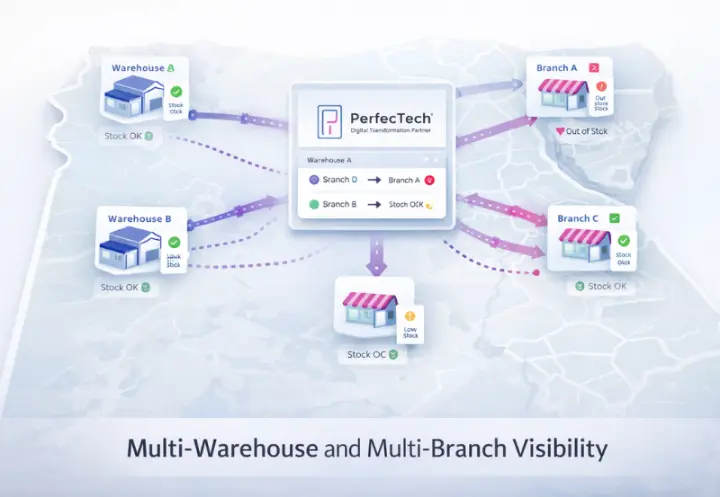
Multi-Warehouse and Multi-Branch Visibility
Many Egyptian companies operate across multiple branches or warehouses. Without centralized inventory monitoring, stock imbalances often occur—some locations carry excess inventory while others face shortages.
Odoo provides unified visibility across all locations, allowing management to rebalance stock and optimize distribution without unnecessary purchasing.
Linking Inventory Decisions to Profitability
Inventory data in Odoo flows directly into financial reporting, enabling leaders to see how stock levels influence margins, revenue performance, and capital allocation.
This connection transforms inventory management from an operational task into a strategic financial tool.
Inventory Discipline as a Growth Strategy
In competitive markets, financial stability depends on how efficiently companies manage their resources. Businesses that control inventory effectively free up working capital, improve purchasing flexibility, and protect profit margins.
When inventory insights are integrated with financial reporting, management gains the clarity required to scale operations without unnecessary financial strain.
Why Choose Perfect Tech for Odoo ERP Implementation in Egypt
Implementing ERP for inventory and working capital optimization requires a deep understanding of operational workflows and financial reporting structures. Inventory configuration, valuation methods, and warehouse processes must align with the realities of Egyptian supply chains.
Perfect Tech delivers Odoo ERP implementations tailored to local business environments. The goal is not simply system deployment, but measurable improvements in inventory visibility, purchasing discipline, and capital efficiency.
Organizations gain the operational clarity required to grow without locking excessive capital in stock.
Strengthening Financial Flexibility in an Uncertain Market
As supply costs fluctuate and demand patterns evolve, Egyptian companies need systems that allow them to adapt quickly. Businesses that rely on fragmented tools often react too slowly to changes in inventory performance.
Integrated ERP platforms such as Odoo provide the operational and financial transparency required to manage stock intelligently while protecting liquidity.
Companies that gain control over inventory flows gain control over their working capital—and ultimately their capacity to grow.
FAQs
Why is inventory management important for working capital?
Inventory directly affects how much cash is tied up in goods that have not yet been sold. Efficient inventory management helps businesses release capital that can be reinvested into operations.
How does Odoo help reduce excess inventory?
Odoo provides real-time stock visibility, turnover analysis, and automated replenishment recommendations based on actual demand patterns.
Can Odoo manage multiple warehouses or branches?
Yes. Odoo offers centralized monitoring of inventory across warehouses and branches, helping companies balance stock levels and avoid unnecessary purchases.
How does inventory data affect financial reporting in Odoo?
Inventory movements are automatically linked to accounting records, ensuring accurate cost of goods sold calculations and real-time financial insight.
Is Odoo suitable for trading and distribution companies in Egypt?
Yes. Odoo’s inventory, purchasing, and financial modules are widely used by trading, retail, and distribution businesses seeking stronger control over stock and capital allocation.