Quick answer
An AI decision support system is software that analyzes business data with machine learning and predictive analytics, then gives managers forecasts, risk alerts, and recommended actions. It collects data from ERP, CRM, finance, and operations, finds patterns people would miss, and predicts likely outcomes, while the final decision stays with people. Enterprises in Saudi Arabia and Egypt use it to plan faster, cut costs, and reduce risk, and its results depend on clean, connected data, usually from an integrated ERP.
Key takeaways
- An AI decision support system supports human judgment; it does not replace decision-makers.
- It works in five stages: collect data, prepare it, find patterns, predict outcomes, and recommend actions.
- Unlike traditional rule-based systems, it learns from new data and looks forward, not only backward.
- Saudi Vision 2030 and Egypt's national AI strategy are pushing enterprises in both markets toward data-driven management.
- The most common use cases are cash flow forecasting, demand planning, sales forecasting, risk detection, and workforce planning.
- Clean, integrated data is the precondition: most enterprises start by consolidating operations in one ERP.
What is an AI decision support system?
An AI decision support system (AI DSS) is an intelligent software layer that helps businesses make better decisions. It analyzes large amounts of operational and financial data, identifies patterns and relationships, and presents insights that would be difficult or slow to obtain through manual reports.
Instead of relying only on spreadsheets, monthly reports, or personal judgment, managers can see what is happening across operations, what is likely to happen next, and which actions are most likely to work.
Important: an AI decision support system does not replace decision-makers. It gives leaders the information to compare scenarios, anticipate problems, and decide with more confidence. Accountability for the decision stays with people.
How does an AI decision support system work?
An AI decision support system collects data from different business sources and turns it into practical insights. The process usually has five stages:
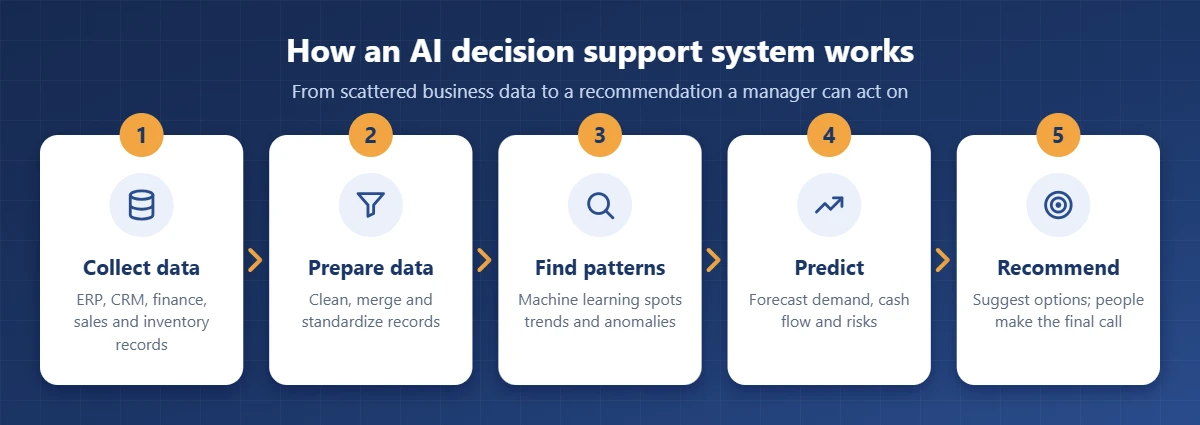
- Data collection: the system gathers information from ERP platforms, CRM systems, financial records, sales reports, and other business applications.
- Data preparation: algorithms clean, merge, and standardize the data so it can be analyzed accurately.
- Pattern recognition: machine learning models find trends, relationships, and unusual patterns that affect performance.
- Predictive analysis: historical and real-time data are used to forecast outcomes, risks, and opportunities.
- Decision recommendations: the system suggests options, with the supporting data, so managers can choose the best course of action.
What makes AI decision support different from traditional decision support systems?
Traditional decision support systems depend on predefined rules, historical reports, and manual analysis. They explain past performance well but struggle with complex patterns and fast-changing conditions. AI-based systems add machine learning, predictive analytics, and automation.
| Aspect | Traditional decision support | AI decision support system |
|---|---|---|
| Logic | Fixed rules set by analysts | Models that learn from new data |
| Time focus | What happened (historical reports) | What will likely happen and what to do |
| Data volume | Limited, mostly structured data | Large, multi-source datasets |
| Pattern detection | Only patterns someone looks for | Finds hidden trends and anomalies |
| Speed | Periodic, manual analysis | Continuous, near real-time insights |
| Output | Reports and dashboards | Forecasts, alerts, and recommended actions |
Why are enterprises in Saudi Arabia and Egypt adopting AI decision support systems?
Businesses in both markets operate in increasingly competitive environments where speed and accuracy matter. As companies grow and generate more data, manual analysis can no longer keep up.
1. Digital transformation under Saudi Vision 2030
Saudi Arabia's Vision 2030 and the National Strategy for Data and AI, led by the Saudi Data and AI Authority (SDAIA), encourage organizations to modernize operations with data and AI. AI decision support helps manufacturing, retail, finance, and healthcare companies analyze operational data and plan resources more strategically.
2. Efficiency pressure in the Egyptian market
Egyptian enterprises face changing costs, currency movements, and evolving customer expectations. Egypt's National AI Strategy also promotes AI adoption across sectors. Bringing data from all departments together lets management see where inefficiencies are and decide on actual performance rather than outdated reports.
3. Growing volumes of business data
Sales transactions, customer interactions, inventory movements, and financial records grow every day. An AI decision support system processes these large datasets, connects related activities, and presents insights in a clear format.
4. Faster, more accurate decisions
Delayed decisions mean missed opportunities and avoidable costs. AI lets managers test scenarios, predict outcomes, and see risks before they become larger problems.
5. Competitiveness and growth
Recognizing market trends, understanding customer behavior, and allocating resources well are the foundation of expansion in both markets.
Key benefits of AI decision support systems for businesses
By analyzing business data and producing actionable insights, an AI decision support system improves how a company decides, operates, and plans.
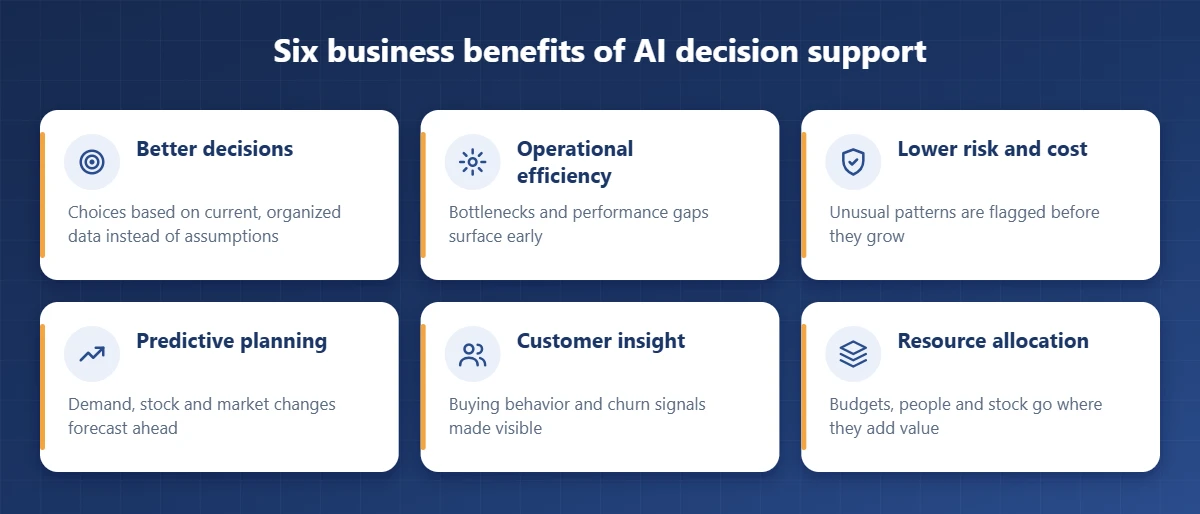
Better decision-making accuracy
Decisions are based on organized, current data rather than assumptions, which reduces the chance of overlooking important details.
Higher operational efficiency
The system analyzes performance, finds bottlenecks, and highlights where resources are wasted, so teams can remove unnecessary work.
Lower business risks and costs
By comparing historical data, current performance, and future scenarios, AI flags unusual patterns early, such as unexpected expense spikes or supplier delays.
Predictive analysis and future planning
Forecasts for demand, inventory, and market changes help businesses prepare instead of react.
Better customer understanding
Analyzing purchasing behavior, interactions, and feedback reveals customer preferences and early signs of churn.
Smarter resource allocation
Budgets, people, equipment, and stock can be directed to the departments and projects where they create the most value.
| Benefit | How it helps | Expected business impact |
|---|---|---|
| Better decision-making | Data-driven insights and recommendations | More informed, confident decisions |
| Operational efficiency | Identifies workflow issues and performance gaps | Higher productivity, smoother operations |
| Risk management | Detects risks and unusual patterns | Fewer surprises, better risk control |
| Predictive analysis | Forecasts trends and outcomes | Better planning for change |
| Customer understanding | Analyzes behavior and preferences | Higher satisfaction and retention |
| Resource optimization | Finds inefficient use of resources | Better cost control and utilization |
How AI decision support systems transform business operations
When information is spread across systems, nobody sees the full picture. An AI decision support system analyzes data from several functions at once and gives each department insights it can act on.
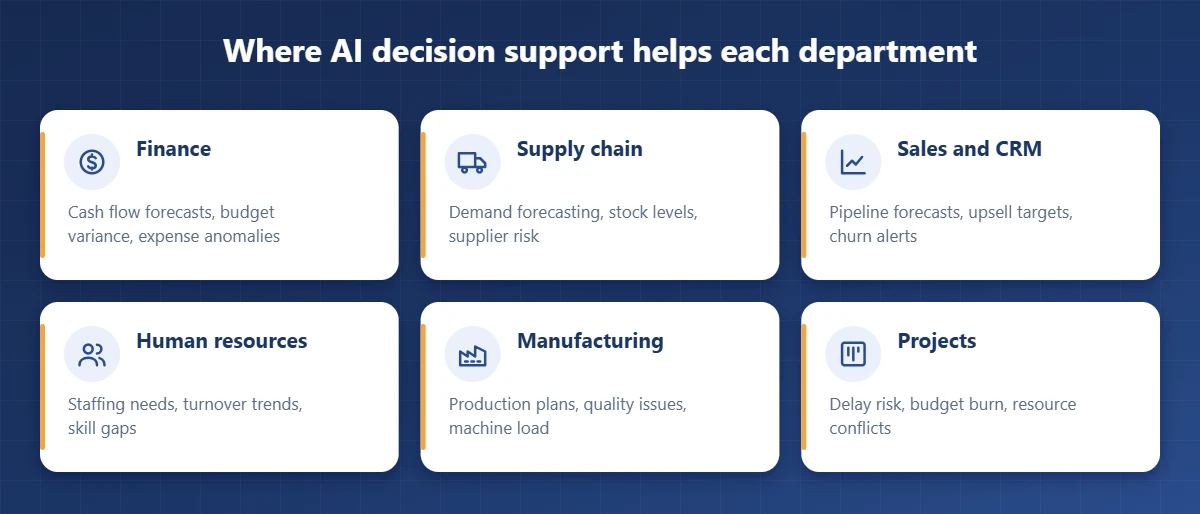
Financial planning and management
Finance teams can track spending patterns, compare actual results with budgets, forecast cash flow, and spot unusual transactions that need review. Learn more about Odoo Finance.
Supply chain and inventory
By analyzing historical sales, stock levels, supplier performance, and demand patterns, AI helps decide what to buy, how much stock to hold, and where disruptions may occur.
Sales and customer relationship management
AI recognizes purchasing patterns, evaluates sales performance, forecasts revenue, and identifies customers likely to buy, or likely to leave. See Odoo Sales.
Human resources and workforce planning
HR teams can anticipate hiring needs, understand turnover patterns, and find skill gaps. Sensitive HR decisions should always be reviewed by people to keep them fair and responsible.
Manufacturing and production
Production data analysis supports better scheduling, earlier detection of quality issues, better use of raw materials, and fewer delays. Explore Odoo Manufacturing.
Project management
AI monitors progress, budget burn, and resource use across projects and flags likely delays early, so managers can adjust plans in time.
| Department | AI application | Business benefit |
|---|---|---|
| Finance | Cash flow forecasting, expense monitoring | Better financial control and budgeting |
| Supply chain | Demand forecasting, inventory analysis | Right stock levels, fewer disruptions |
| Sales | Customer behavior analysis, sales forecasting | Better strategies and engagement |
| Human resources | Workforce analysis, staffing predictions | More effective workforce planning |
| Manufacturing | Production analysis, quality monitoring | Higher efficiency, better planning |
| Projects | Progress tracking, risk identification | Better resource allocation and control |
How to get started with AI decision support
Successful AI projects usually start small and build on a solid data foundation:
- Pick one decision to improve. For example, purchasing quantities, cash flow planning, or sales forecasting.
- Consolidate the data. Bring sales, purchasing, inventory, finance, and HR into one integrated ERP so the AI has a single source of truth.
- Clean master data. Fix duplicate customers and products, missing fields, and inconsistent units.
- Build dashboards first. Clear KPIs show what "good" looks like before predictions are added.
- Add AI models and measure. Compare AI recommendations with real outcomes, then expand to the next use case.
- Protect data. Follow the Saudi Personal Data Protection Law (PDPL) and Egypt's Data Protection Law No. 151 of 2020, and apply role-based access.
Why choosing the right technology partner matters
AI delivers value only when it fits real processes and existing systems. When comparing partners, ask:
- Do they start from your business decisions and goals, not from the technology?
- Can they integrate AI with your ERP, CRM, and financial systems?
- How do they ensure data quality, security, and privacy compliance?
- Will recommendations be explainable to managers?
- Do they provide training and long-term support?
Perfect Tech is an Odoo Gold Partner serving enterprises in Saudi Arabia and Egypt. We help companies build the data foundation that AI decision support depends on: an integrated Odoo ERP, clean master data, management dashboards, and integrations with analytics tools. Browse our customer success stories or our Odoo services.
Ready to make decisions with better data?
Tell us which decisions matter most to your business, and we will show you how to connect your data and turn it into clear, actionable insights.
Talk to an expertFrequently asked questions
What is the main purpose of an AI decision support system?
Its purpose is to help managers make better decisions by analyzing large amounts of business data, finding patterns, forecasting outcomes, and suggesting options. It supports human judgment rather than replacing it.
What is the difference between AI and traditional decision support systems?
Traditional decision support systems rely on fixed rules, historical reports, and manual analysis. An AI decision support system uses machine learning and predictive analytics, so it can learn from new data, detect complex patterns, and give forward-looking recommendations.
Are AI decision support systems suitable for small and medium-sized businesses?
Yes. A mid-sized company can start with one use case, such as demand or cash flow forecasting, using data already in its ERP. The right scope depends on data quality, business needs, and budget.
Which industries benefit most from AI decision support?
Manufacturing, retail and e-commerce, distribution and logistics, construction and real estate, healthcare, banking and financial services, and education all use AI decision support, mainly for forecasting, risk detection, and resource planning.
Can an AI decision support system integrate with ERP and CRM software?
Yes. Most AI decision support solutions read data from ERP and CRM systems through APIs or data exports. A well-implemented ERP such as Odoo gives the AI one clean, connected source of sales, purchasing, inventory, finance, and HR data.
Do enterprises need clean data before adopting AI?
Yes. AI recommendations are only as reliable as the data behind them. Consolidating operations in one ERP, standardizing master data, and fixing duplicate or missing records usually comes before any AI project.
How should an enterprise choose an AI decision support system?
Check compatibility with existing systems, data security and privacy compliance (Saudi PDPL or Egypt Data Protection Law No. 151 of 2020), ease of use, scalability, how explainable the recommendations are, and the implementation and support offered.
How can Perfect Tech help with AI decision support?
Perfect Tech, an Odoo Gold Partner in Saudi Arabia and Egypt, helps enterprises build the data foundation AI needs: an integrated Odoo ERP, clean master data, dashboards and reports, and integrations with analytics and AI tools.