Odoo Maintenance Management in Egypt: How Manufacturers Can Reduce Downtime and Control Equipment Performance
A production line does not need to stop completely for poor maintenance management to become expensive.
A machine operating below normal efficiency can slow production.
An unexpected breakdown can interrupt an entire work center.
A missing spare part can extend a repair.
Repeated failures can consume maintenance resources without addressing the underlying cause.
And when maintenance information is scattered across spreadsheets, paper forms, WhatsApp messages, or individual technicians' records, management may struggle to understand which assets are creating the greatest operational risk.
For manufacturers in Egypt, maintenance is therefore not simply a technical activity.
It is part of production performance, asset utilization, cost control, delivery reliability, and ultimately profitability.
This is where Odoo Maintenance management in Egypt can create significant value.
Odoo Maintenance provides an integrated environment for managing equipment, work centers, preventive maintenance, corrective maintenance, maintenance teams, schedules, requests, and equipment-performance metrics.
When Maintenance operates alongside Odoo Manufacturing, Inventory, Purchase, and Accounting, maintenance activity becomes connected to the wider operational environment rather than remaining an isolated engineering function.
For Egyptian manufacturers looking to build this wider operating model, Perfect Tech provides Odoo Manufacturing ERP solutions that connect production, maintenance, inventory, procurement, quality, costing, and financial operations within one ERP environment.
Why Maintenance Management Becomes Critical as Manufacturing Operations Grow
Maintenance may be relatively easy to manage in a small workshop with a limited number of machines.
As manufacturing operations grow, the situation changes.
A factory may operate several production lines, dozens of machines, multiple work centers, specialized tools, compressors, generators, packaging equipment, utilities, forklifts, and other production-critical assets.
Each asset may have different maintenance requirements.
Some equipment requires inspection every week.
Other machines require maintenance after a particular operating period.
Certain assets may have warranty conditions.
Some failures may stop one workstation.
Others can interrupt an entire production line.
At that scale, informal maintenance becomes increasingly difficult to control.
Management needs to know:
Which equipment is failing most frequently?
How long does each repair normally take?
When is the next preventive maintenance activity scheduled?
Which technician is responsible?
Which production areas are most vulnerable to breakdowns?
Which machines repeatedly interrupt manufacturing?
What maintenance work is planned for the coming week?
And how does downtime affect production performance?
Without structured maintenance data, many of these questions are answered only after a problem has already affected operations.
A modern maintenance system should make this information visible before maintenance becomes a production crisis.
Preventive Maintenance vs Corrective Maintenance
Maintenance generally falls into two important categories.
Corrective maintenance happens after a problem occurs.
A machine fails, performance deteriorates, or equipment becomes unusable, and the maintenance team responds to restore it.
Preventive maintenance is planned before the failure.
The objective is to inspect, service, replace, lubricate, calibrate, clean, or otherwise maintain equipment before a predictable issue becomes an unexpected breakdown.
Odoo supports both models.
According to the official Odoo Maintenance documentation, maintenance requests can be categorized as either preventive or corrective and can be scheduled and tracked against equipment and work centers.
The objective is not to eliminate corrective maintenance entirely.
Unexpected failures can still happen.
The goal is to reduce unnecessary reactive maintenance by giving teams better visibility into equipment history, planned interventions, failure patterns, and upcoming maintenance requirements.
Why Reactive Maintenance Can Become Expensive
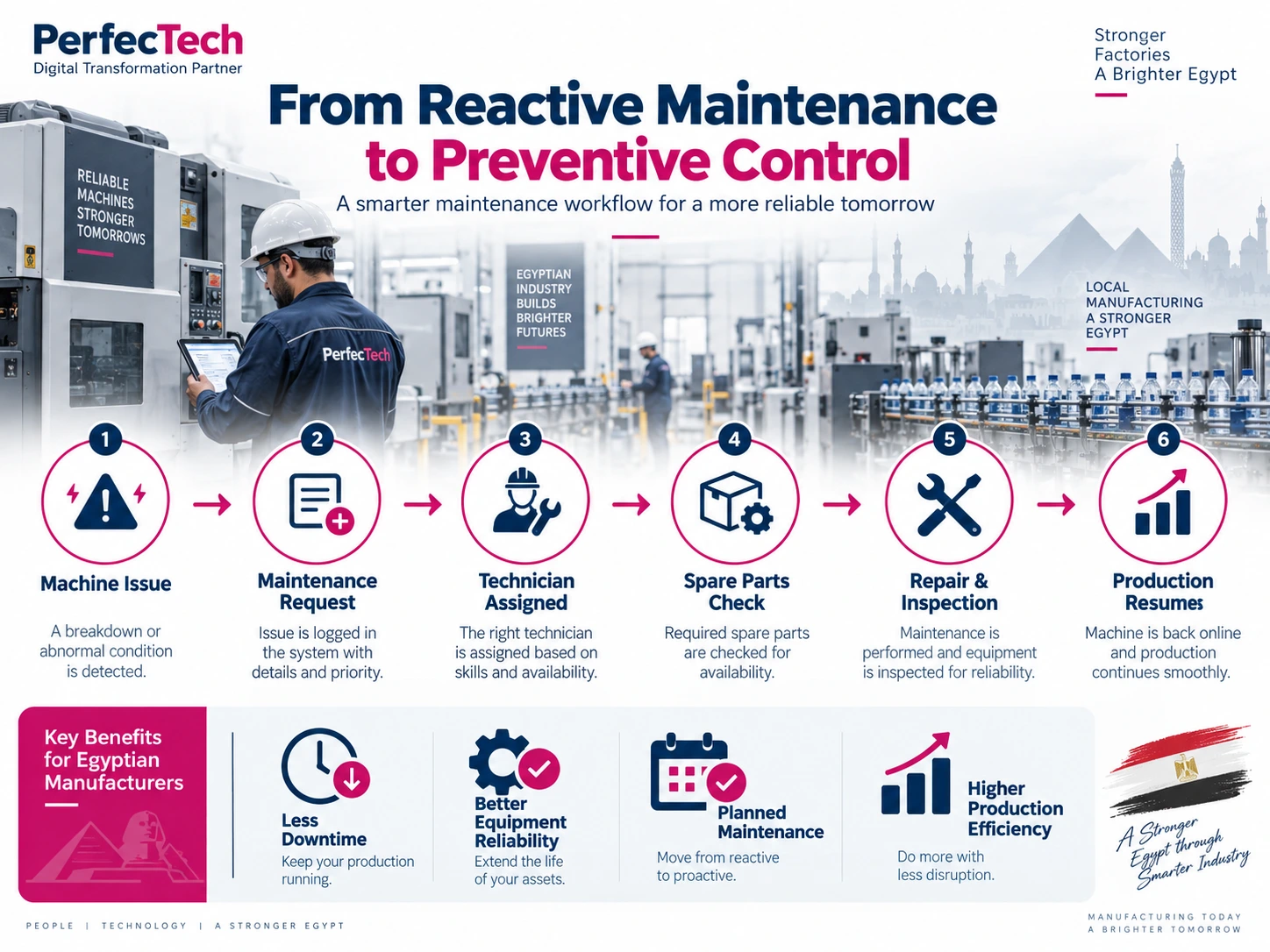
A reactive approach may appear cheaper because maintenance work only happens when something breaks.
But the true cost of a breakdown is rarely limited to the technician's repair time.
Consider a critical machine that stops unexpectedly.
Production may stop.
Operators may remain idle.
A production schedule may need to be changed.
Another manufacturing order may be delayed.
A customer delivery date may be affected.
A replacement part may need to be sourced urgently.
Procurement may pay more for faster delivery.
Quality may need to inspect production affected before the failure.
Management may need to reorganize capacity across other work centers.
The repair itself is only one part of the operational impact.
This is why maintenance should be considered alongside production planning rather than as a separate engineering issue.
With a connected Odoo Manufacturing ERP environment, maintenance information can operate much closer to the manufacturing processes it protects.
Build a Digital Equipment Register
Effective maintenance management begins with knowing what equipment the organization actually needs to maintain.
Odoo allows businesses to create equipment records containing information such as equipment category, assigned work center, responsible employee, maintenance team, vendor, vendor reference, model, serial number, acquisition date, equipment cost, and warranty expiration.
The Odoo equipment documentation also allows equipment to be linked to specific work centers.
This creates a digital equipment register instead of relying on separate Excel files or technician-specific records.
For each machine, the organization can begin building an operational history around the asset.
That history becomes increasingly valuable over time.
A machine is no longer simply identified by its model and serial number.
Management can begin understanding its maintenance behavior.
How frequently does it fail?
How long does it take to repair?
What maintenance requests have been created?
What work center depends on it?
When did the last failure occur?
When might another intervention be required?
The equipment record becomes part of the operational knowledge of the factory.
Connect Equipment to Manufacturing Work Centers
Maintenance becomes more valuable when equipment is connected to the production environment where it operates.
Odoo allows equipment to be associated with work centers.
A work center might represent a production station, machine group, assembly area, packaging operation, cutting station, mixing unit, or another manufacturing resource.
This relationship matters because the condition of equipment directly affects the capacity of that work center.
If a critical machine becomes unavailable, the operational consequence is not simply that one asset is under repair.
Manufacturing capacity may also become constrained.
By organizing equipment around work centers, maintenance data can be evaluated in its production context.
Perfect Tech's manufacturing ERP solutions are designed around this broader relationship between production planning, shop-floor activity, equipment, quality, inventory, maintenance, and costing.
Schedule Preventive Maintenance Before Failure Occurs
Preventive maintenance only works when planned activities actually become visible and actionable.
A spreadsheet may contain a maintenance schedule, but the value of that schedule depends on somebody opening the file, identifying what is due, assigning the work, and following up until completion.
Odoo provides a Maintenance Calendar where preventive and corrective maintenance requests can be scheduled and managed.
This allows maintenance teams to see upcoming interventions within a structured calendar rather than relying only on memory or disconnected reminders.
Technicians and maintenance teams can be assigned responsibility for specific requests.
Scheduled dates can be defined.
Maintenance activities can then progress through a controlled workflow.
For maintenance managers, the result is stronger visibility into workload.
For production teams, planned maintenance becomes easier to coordinate with manufacturing activity.
For management, maintenance changes from an unpredictable technical function into a more structured operating process.
Track Maintenance Requests Instead of Informal Messages
In many factories, the first indication of an equipment problem is informal.
An operator calls a technician.
A supervisor sends a WhatsApp message.
Somebody writes the issue on paper.
The technician fixes the problem.
Production restarts.
The incident is forgotten.
That may solve the immediate breakdown, but the organization loses valuable information.
Was this the first failure?
Has the same problem happened five times?
How long did each repair take?
Was one technician repeatedly assigned?
Was the issue associated with a particular manufacturing order?
Did the machine fail again shortly afterward?
Odoo allows teams to create structured maintenance requests.
Requests can include the equipment or work center affected, maintenance type, assigned team, responsible technician, scheduled date, duration, priority, and relevant notes.
When the request relates to a manufacturing issue, Odoo can also associate it with a specific manufacturing order and work order.
That link is particularly valuable.
The maintenance event is no longer separated from the production context in which it occurred.
Understand MTBF: Mean Time Between Failures
One of the most useful maintenance metrics is MTBF — Mean Time Between Failures.
MTBF measures the average operating time between reported equipment failures.
A higher MTBF generally indicates that an asset operates for longer periods between failures.
A declining MTBF can indicate that a machine is becoming less reliable.
Odoo calculates the Mean Time Between Failure for equipment based on completed corrective maintenance activity.
The equipment record can also include an expected MTBF, allowing maintenance teams to compare expected reliability with actual equipment behavior.
The official Odoo equipment documentation explains that Odoo can calculate MTBF from historical failures and use maintenance information to estimate the next potential failure date.
This turns maintenance history into a management signal.
Imagine two similar machines.
Machine A fails approximately every 180 days.
Machine B fails approximately every 35 days.
Without structured data, both machines may simply appear operational whenever management walks through the factory.
Maintenance history tells a very different story.
Machine B may require deeper investigation, replacement planning, changes to operating conditions, or a different preventive-maintenance strategy.
Understand MTTR: Mean Time to Repair
Failure frequency is only part of the reliability picture.
Management also needs to know how quickly equipment returns to operation.
MTTR — Mean Time to Repair measures the average amount of time required to repair equipment after failure.
Odoo calculates MTTR based on the duration of previous maintenance requests.
This allows maintenance managers to identify equipment that is not only failing but also taking too long to restore.
Consider two assets.
Both fail four times each year.
The first machine normally returns to service within one hour.
The second requires an average of two days to repair.
Their operational risk is very different.
The second asset may require difficult-to-source spare parts, specialist technical knowledge, external servicing, or a replacement strategy.
MTTR gives management a clearer picture of that risk.
Use Estimated Next Failure as a Planning Signal
Odoo can also calculate an Estimated Next Failure date based on recorded maintenance data.
According to Odoo's documentation, this estimate uses information including the latest failure and Mean Time Between Failure.
This should not be interpreted as a guarantee that a machine will fail on a specific date.
Equipment failure depends on many factors that an ERP system cannot predict perfectly.
However, historical failure behavior can provide a useful planning signal.
Maintenance teams can use this information alongside manufacturer recommendations, technician knowledge, operating conditions, inspection results, and preventive-maintenance schedules.
The result is better maintenance planning than simply waiting until equipment stops.
Maintenance Management Should Support Production Planning
Maintenance and production naturally compete for machine time.
Production wants equipment operating.
Maintenance sometimes needs that equipment stopped.
If the two departments plan independently, preventive maintenance can easily be postponed because production appears more urgent.
Repeated postponement creates another risk.
A planned one-hour maintenance activity may eventually become an unplanned eight-hour breakdown.
The solution is not for maintenance to override production.
It is for both teams to operate with shared visibility.
A connected ERP environment allows maintenance schedules to be considered alongside production plans, work centers, manufacturing orders, and equipment availability.
This is one of the reasons manufacturers increasingly need an integrated ERP model rather than separate production and CMMS databases.
The objective is coordination.
Maintenance and Overall Equipment Performance
Maintenance data provides another layer of understanding around equipment performance.
A machine may appear productive when it is running.
But if it stops frequently, requires repeated repairs, or creates production interruptions, its true operational performance may be weaker than expected.
Management should therefore analyze maintenance alongside production information.
Useful questions include:
How much production depends on this asset?
How frequently does it fail?
How long does repair normally take?
Is preventive maintenance reducing failures?
Are breakdowns increasing over time?
Does the machine create bottlenecks?
Would replacing the asset cost less than continued disruption?
These questions move maintenance beyond technical activity and into operational decision-making.
Connect Maintenance with Manufacturing Orders
A maintenance request may originate directly from production.
An operator notices abnormal vibration.
A work center stops unexpectedly.
A machine begins producing inconsistent results.
A technician is called while a manufacturing order is running.
Odoo Maintenance allows a maintenance request to be associated with a specific Manufacturing Order and, where relevant, a Work Order.
This creates useful traceability between production and equipment incidents.
The business can understand not only that a machine failed, but where the failure occurred in the manufacturing process.
Over time, this history can support deeper operational analysis.
Certain products or operations may place unusual stress on equipment.
Specific work centers may experience repeated interruptions.
Maintenance incidents may cluster around particular production conditions.
Connecting manufacturing and maintenance gives management the data required to investigate those patterns.
Maintenance and Quality Should Not Operate in Isolation
Equipment condition can affect quality.
Incorrect calibration, worn tooling, poor alignment, temperature instability, pressure variation, damaged components, or deteriorating machines can contribute to inconsistent output.
This means quality problems should sometimes trigger a maintenance investigation.
Similarly, maintenance activity may require quality verification before equipment returns to normal production.
An integrated manufacturing environment makes this relationship easier to manage because production, quality, and maintenance do not need to exist in completely separate systems.
Perfect Tech's Odoo manufacturing solutions can connect Manufacturing, Quality, Maintenance, Inventory, Purchase, and Accounting around the same operating environment.
For factories with formal quality requirements, this can provide much stronger traceability than maintaining separate engineering and quality records.
Maintenance and Spare Parts Management
A maintenance team cannot repair equipment quickly if the required spare part is unavailable.
This creates another connection between maintenance and the broader ERP system.
Critical spare parts may need minimum stock levels.
Certain components may have long supplier lead times.
Others may be expensive and should not be overstocked.
Some spare parts may be shared across several machines.
The organization therefore needs to balance maintenance readiness against inventory cost.
By operating maintenance alongside inventory and procurement, the business can build a more coordinated strategy for maintenance materials.
Purchasing information can remain connected to suppliers.
Inventory can track availability.
Replenishment can support critical stock policies.
Finance can see the cost of maintaining spare-parts inventory.
For manufacturers, this is another reason maintenance should not be treated as an isolated software function.
Connect Maintenance Costs with Financial Visibility
Maintenance has a financial impact whether it is measured or not.
The business spends money on technicians, spare parts, external contractors, replacement components, tools, and equipment.
Breakdowns can also create indirect costs through lost production, overtime, delayed deliveries, emergency procurement, and lower capacity utilization.
Not every one of these costs can be automatically attributed to a machine simply by installing maintenance software.
But connecting maintenance with the wider ERP gives the organization a stronger foundation for financial analysis.
Purchasing and inventory provide information about materials and spare parts.
Accounting records supplier bills and expenditure.
Manufacturing captures production activity.
Maintenance provides equipment history and intervention records.
Together, these systems create a more complete operational picture.
Perfect Tech's Odoo Finance solutions help organizations connect financial reporting with operational activities across purchasing, inventory, manufacturing, projects, and other ERP processes.
Maintenance for Multi-Site Manufacturing Operations
Maintenance becomes significantly more complex when a manufacturer operates several factories or production sites.
Each location may have its own equipment, technicians, maintenance teams, spare-parts stores, and operational priorities.
Management needs both local control and group-level visibility.
A plant maintenance manager needs detailed information about today's maintenance workload.
Senior management may need to understand asset reliability across the entire organization.
Which facility experiences the most breakdowns?
Which work centers create the greatest operational risk?
Where are maintenance resources being consumed?
Which machines may require replacement?
Where should preventive-maintenance policies be standardized?
For larger manufacturers, maintenance architecture therefore needs to fit within the wider enterprise structure.
Perfect Tech's Odoo Enterprise ERP solutions in Egypt are designed for organizations that require structured operations across multiple entities, branches, warehouses, factories, teams, and reporting levels.
Preventive Maintenance Does Not Mean Maintaining Everything More Often
A common misconception is that preventive maintenance simply means increasing maintenance frequency.
That can create its own inefficiencies.
Stopping equipment unnecessarily consumes technician time and can interrupt production.
A better maintenance strategy focuses on the right intervention at the right time.
Different assets require different strategies.
A critical production machine may require strict scheduled maintenance.
A low-risk piece of equipment may need a lighter inspection cycle.
Equipment with repeated failures may need deeper technical investigation rather than simply more frequent routine servicing.
A new machine under warranty may have manufacturer-defined service intervals.
Older equipment may require closer monitoring.
The maintenance system should support these different approaches rather than applying the same rule to every asset.
Create Accountability Across Maintenance Teams
Maintenance work becomes difficult to manage when responsibility is unclear.
Who received the request?
Who is assigned?
When is the work scheduled?
Has the job started?
Has the machine returned to operation?
Is the request still open?
Odoo allows maintenance requests to be assigned to maintenance teams and responsible users.
The Odoo Maintenance setup documentation explains how maintenance teams can be configured and how technicians appear within the Maintenance Calendar.
This creates clearer ownership around maintenance work.
It also gives maintenance managers visibility into how requests are distributed across technicians and teams.
Move from Maintenance Records to Maintenance Intelligence
The first benefit of digital maintenance management is organization.
The larger benefit appears after the organization accumulates reliable maintenance history.
Equipment records become more meaningful.
Failure frequency becomes visible.
Repair duration becomes measurable.
Preventive interventions can be compared with corrective activity.
Repeated failure patterns can be investigated.
Estimated failure dates can support planning.
Maintenance managers can begin identifying where the greatest reliability problems exist.
This changes the conversation.
Instead of asking:
“What broke today?”
management can begin asking:
“Why does this equipment keep breaking, what is the operational impact, and what should we change?”
That is a much more valuable use of maintenance data.
When Should a Manufacturer Replace Equipment Instead of Repairing It?
ERP software cannot make an equipment replacement decision automatically.
But it can provide useful evidence.
An asset that fails frequently, requires long repairs, consumes expensive spare parts, interrupts production, and becomes increasingly unreliable may eventually cost more to retain than to replace.
Maintenance records provide part of that evidence.
Management can combine maintenance history with equipment acquisition cost, age, production importance, replacement cost, capacity requirements, and financial planning.
Odoo's equipment records can include information such as acquisition cost, effective date, warranty expiration, MTBF, MTTR, latest failure, and estimated next failure.
This gives managers a stronger factual foundation for asset-replacement discussions.
From Spreadsheet Maintenance to Integrated ERP
Many manufacturers begin maintenance management in Excel.
A spreadsheet may contain equipment names, maintenance dates, and technician notes.
That approach can work at limited scale.
The problem appears when maintenance becomes connected to dozens of other operational decisions.
Equipment belongs to work centers.
Work centers affect manufacturing orders.
Breakdowns affect production.
Repairs require spare parts.
Spare parts require inventory.
Inventory requires purchasing.
Purchasing creates financial transactions.
Downtime affects capacity and delivery.
At this stage, the maintenance spreadsheet becomes only one isolated piece of a much larger operational puzzle.
An integrated ERP environment connects those relationships.
That is the strategic difference between simply digitizing a maintenance log and building maintenance into the operating model of the factory.
Why Choose Perfect Tech for Odoo Maintenance and Manufacturing in Egypt?
Maintenance implementations should not begin with software screens.
They should begin with the factory.
The implementation team needs to understand equipment structures, production lines, work centers, maintenance responsibilities, breakdown processes, preventive schedules, spare-parts requirements, production dependencies, quality controls, and financial reporting.
Perfect Tech is officially listed by Odoo as a Gold Partner in Egypt.
Odoo's current partner profile lists Perfect Tech with 85 customer references, including 19 references in Manufacturing / Maintenance, alongside references in wholesale, construction, real estate, education, utilities, healthcare, agriculture, and other sectors.
This manufacturing exposure is particularly relevant when maintenance is being implemented as part of a wider ERP environment rather than as an isolated CMMS.
Perfect Tech can design Odoo Maintenance together with manufacturing, inventory, procurement, quality, finance, and reporting so that equipment management supports the wider operating model of the business.
Egyptian manufacturers can explore Perfect Tech's Odoo Manufacturing ERP solutions or Odoo Enterprise ERP solutions in Egypt to understand how maintenance can become part of a complete digital manufacturing architecture.
Frequently Asked Questions
How does Odoo Maintenance help manufacturers reduce downtime?
Odoo Maintenance helps manufacturers structure preventive and corrective maintenance around equipment and work centers. Teams can create maintenance requests, schedule interventions, assign technicians, track equipment history, and monitor reliability indicators such as Mean Time Between Failures and Mean Time to Repair.
When Maintenance is connected with Manufacturing, equipment issues can also be associated with manufacturing orders and work orders, creating stronger visibility into how equipment reliability affects production.
The official Odoo Maintenance documentation provides the current functionality available within the application.
What is preventive maintenance in Odoo?
Preventive maintenance is maintenance planned before equipment failure with the objective of reducing the likelihood of unexpected breakdowns.
Odoo allows users to create preventive maintenance requests, schedule them, assign responsible teams or technicians, and manage them through the maintenance workflow.
The process can be managed through Odoo's maintenance requests and Maintenance Calendar.
What is corrective maintenance in Odoo?
Corrective maintenance is maintenance carried out in response to an existing equipment problem or failure.
In Odoo, a maintenance request can be classified as corrective when equipment or a work center requires repair.
These requests can then be assigned, scheduled, tracked, and connected to the relevant equipment.
Can Odoo track machine failures?
Yes.
Odoo equipment records include maintenance information based on recorded maintenance activity.
The system can track the latest failure and calculate maintenance indicators including Mean Time Between Failures and Mean Time to Repair.
Equipment details can be reviewed in the Odoo equipment management documentation.
What is MTBF in Odoo?
MTBF means Mean Time Between Failures.
It represents the average time between reported equipment failures.
Odoo calculates MTBF using completed corrective maintenance history and displays it within the equipment's maintenance information.
Manufacturers can use this metric as one indicator of equipment reliability.
What is MTTR in Odoo?
MTTR means Mean Time to Repair.
It measures the average time required to repair a piece of equipment after failure.
Odoo calculates MTTR using the duration of completed maintenance requests.
A high MTTR may indicate that an asset is particularly difficult or slow to restore after failure.
Can Odoo predict when equipment will fail?
Odoo provides an Estimated Next Failure date based on recorded failure history and MTBF.
This should be treated as a planning indicator rather than a guaranteed prediction of an exact future breakdown.
Actual failure risk can depend on operating conditions, usage, machine age, maintenance quality, environment, and other physical factors.
Can Odoo Maintenance connect with Manufacturing?
Yes.
Maintenance requests can be linked to manufacturing orders and work orders when an issue is associated with production.
Equipment can also be connected to work centers.
This makes Maintenance particularly useful within a broader Odoo Manufacturing ERP environment.
Can Odoo schedule preventive maintenance?
Yes.
Odoo provides a Maintenance Calendar where preventive and corrective maintenance activities can be created, scheduled, and managed.
Maintenance teams and responsible technicians can also be assigned to requests.
Can Odoo manage maintenance teams and technicians?
Yes.
Businesses can configure maintenance teams and team members within Odoo.
Specific teams and responsible technicians can then be assigned to maintenance requests.
This helps establish clearer ownership and workload visibility.
Can Odoo store equipment serial numbers and warranty information?
Yes.
Equipment records can include information such as vendor, vendor reference, model, serial number, effective date, acquisition cost, and warranty expiration.
This makes the equipment record useful for both maintenance operations and asset information management.
Can Odoo Maintenance be used outside manufacturing?
Yes.
Odoo defines equipment broadly and can track items used in everyday operations, not only production machinery.
Maintenance may therefore be relevant for warehouses, facilities, service organizations, equipment-intensive operations, utilities, and other organizations managing physical assets.
The precise configuration should reflect the type of equipment and maintenance process involved.
Is Odoo Maintenance suitable for multiple factories?
Odoo can support equipment, work centers, maintenance teams, and multi-company environments.
For larger organizations operating multiple factories or legal entities, however, the maintenance structure should be designed as part of the wider enterprise architecture.
Perfect Tech's Odoo Enterprise ERP solutions in Egypt are designed for organizations with more complex operational structures.
Who can implement Odoo Maintenance for factories in Egypt?
Perfect Tech is officially listed by Odoo as a Gold Partner in Egypt and currently has multiple Odoo customer references in Manufacturing / Maintenance.
Perfect Tech can implement Maintenance as part of an integrated Odoo environment connecting manufacturing, inventory, procurement, quality, accounting, reporting, and other operational processes.
Turn Maintenance from Emergency Response into Operational Control
A strong maintenance strategy does not guarantee that machinery will never fail.
Its purpose is to give the business more control over how equipment is maintained, how failures are handled, and how maintenance information supports operational decisions.
For Egyptian manufacturers, that means moving beyond isolated spreadsheets, technician memory, and reactive repair requests.
Equipment can be registered.
Maintenance history can be preserved.
Preventive activities can be scheduled.
Corrective work can be tracked.
Technicians can have clear responsibility.
MTBF and MTTR can provide reliability indicators.
Maintenance incidents can remain connected to manufacturing activity.
And management can develop a clearer understanding of which assets are supporting production and which assets are becoming operational risks.
When maintenance, manufacturing, inventory, procurement, quality, and finance operate inside a connected ERP environment, equipment management becomes part of the wider business strategy.
Looking to improve maintenance and manufacturing control with Odoo in Egypt?
Perfect Tech can assess your current maintenance workflows, equipment structure, work centers, production processes, and ERP environment before designing an Odoo solution around your factory's actual requirements.