Managing Multi-Campus and Multi-Country Operations with Control
Large education groups do not scale like traditional businesses. Growth does not only mean more students or additional campuses. It introduces academic governance, regulatory compliance, financial oversight, and operational coordination across institutions that often operate under different educational frameworks.
For Egyptian education providers expanding regionally, complexity multiplies quickly. Each country introduces new accreditation requirements, tuition structures, payroll models, and reporting obligations. What begins as academic expansion soon becomes an operational challenge that traditional systems struggle to support.
Education enterprises do not fail because of demand. They fail when systems cannot keep pace with institutional growth.
Why Disconnected Systems Undermine Education Group Performance
Many large education groups rely on a mix of student management systems, accounting software, HR tools, and spreadsheets. These systems often operate independently, creating fragmented data environments.
Leadership struggles to answer fundamental questions with confidence. Financial performance varies by campus without clear explanations. Faculty costs grow without visibility into productivity. Student data becomes siloed across departments and countries.
At enterprise scale, disconnected systems do not support academic excellence. They dilute control and accountability.
Education Enterprises Require Central Governance Without Academic Rigidity
Education groups must balance institutional autonomy with group-wide governance. Campuses need flexibility to adapt to local academic standards, while headquarters must enforce financial discipline, compliance, and reporting consistency.
This balance cannot be achieved through policy alone. It requires a system that aligns academic operations, finance, and HR under a unified governance framework without interfering in day-to-day academic delivery.
ERP architecture becomes the backbone that enables this balance.
ERP as the Institutional Operating System for Education Groups
In large education groups, ERP is not an administrative layer. It defines how institutions interact, how performance is measured, and how leadership maintains oversight across campuses.
An enterprise-grade ERP environment connects admissions, finance, HR, procurement, and asset management into a single operational framework. This allows education groups to operate cohesively while preserving academic independence.
ERP transforms education management from fragmented administration into structured institutional intelligence.
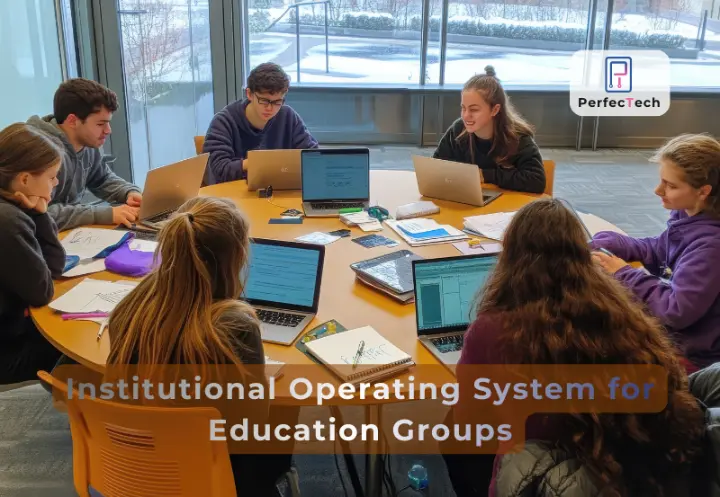
Odoo ERP for Multi-Campus and Multi-Country Education Structures
Odoo supports complex education environments by enabling multiple institutions, campuses, and countries within a single ERP ecosystem.
Each campus can maintain its own tuition structures, academic calendars, and payroll rules while contributing to centralized reporting and governance. Leadership gains real-time insight into enrollment trends, financial performance, and resource utilization across the group.
This architecture supports regional growth without forcing uniformity across institutions.
Financial Visibility Across Institutions and Countries
Education groups often underestimate the importance of financial consolidation until complexity becomes unmanageable.
ERP-driven financial architecture enables real-time visibility into tuition revenue, operational costs, and profitability by campus or country. Currency exposure, faculty payroll, and capital expenditures become transparent.
Financial clarity allows leadership to make informed decisions about expansion, investment, and resource allocation.
Managing Faculty, Staff, and HR at Enterprise Scale
Human capital is the most critical asset in education enterprises. Managing faculty and staff across institutions without unified systems leads to inconsistency and inefficiency.
ERP enables standardized HR governance while supporting local employment regulations. Recruitment, payroll, performance tracking, and workforce planning align across campuses, reducing administrative overhead and compliance risk.
This creates a stable foundation for academic excellence.
Asset and Infrastructure Control Across Campuses
Large education groups manage extensive physical assets, from classrooms and laboratories to IT infrastructure and facilities.
ERP provides centralized asset management, maintenance tracking, and capital planning across campuses. This ensures optimal utilization of resources and supports long-term infrastructure strategy.
Operational transparency strengthens institutional sustainability.
Why Education Groups Choose Perfect Tech Egypt
Education enterprises require ERP partners who understand institutional complexity, not just software features.
Perfect Tech Egypt designs ERP architectures aligned with academic governance, financial oversight, and regional expansion needs. The focus is on long-term institutional stability rather than short-term system deployment.
Final Perspective: Education Scale Requires Institutional Intelligence
For large education groups, ERP defines how institutions grow, collaborate, and remain accountable.
The right ERP architecture transforms expansion from administrative burden into structured growth, enabling education providers to scale confidently across campuses and countries.
Yes. ERP provides centralized governance and visibility while allowing campus-level flexibility.
Yes. Odoo supports multi-company and multi-country education structures with localized configurations.
No. ERP supports governance and operations without dictating academic delivery.
ERP provides consolidated financial visibility, budgeting, and cost control across institutions.
Perfect Tech Egypt specializes in enterprise ERP architecture tailored to complex education environments.