Digital Procurement & Supply Chain ERP for Saudi Enterprises
The Procurement Governance Gap in Saudi Enterprises, as Saudi enterprises expand across regions, suppliers, and distribution networks, procurement often becomes fragmented across departments and systems. Manual approvals, disconnected supplier data, and delayed visibility create hidden cost leakage and supply chain risk. Modern ERP architecture closes this gap by enforcing procurement governance at the point of decision, integrating suppliers, inventory, logistics, and finance into one control framework. For CEOs and COOs, digital procurement is no longer an efficiency upgrade—it is foundational infrastructure for resilience, margin protection, and scalable growth.
When Procurement Stops Being Operational and Becomes Strategic
In early-stage organizations, procurement is typically treated as an operational task focused on buying goods at the lowest price. As Saudi enterprises scale, this view becomes dangerously incomplete.
Procurement decisions begin to shape cash flow, supplier dependency, inventory exposure, and service reliability. Each purchase commitment carries financial and operational consequences that ripple across warehouses, logistics partners, and customer delivery timelines.
At enterprise scale, procurement is not a cost center. It is a strategic control function.
Why Procurement Fragmentation Undermines Supply Chain Stability
Many Saudi enterprises manage procurement through a patchwork of tools. Purchase requests flow through emails. Supplier records live in multiple systems. Inventory data is disconnected from real demand. Finance teams discover cost overruns only after commitments are made.
This fragmentation creates blind spots. Leadership cannot accurately assess supplier exposure. Emergency purchases bypass policy. Contract compliance weakens. Inventory imbalances grow quietly until they disrupt operations.
Supply chain failure is rarely sudden. It accumulates silently through fragmented procurement.
ERP as the Control Plane for Enterprise Procurement
Enterprise ERP transforms procurement by embedding governance directly into workflows.
Approval hierarchies, budget controls, supplier rules, and compliance requirements are enforced automatically as part of the procurement process. Decisions are validated before commitments are issued, not reconciled afterward.
This shift moves procurement from reactive coordination to proactive control.
Supplier Visibility as a Risk Management Discipline
Saudi enterprises increasingly rely on regional and international suppliers. Without centralized visibility, supplier dependency and performance risk remain hidden.
ERP provides a unified supplier master, performance history, and contract alignment. Leadership can evaluate supplier concentration, delivery reliability, and pricing behavior across the enterprise. Strategic sourcing decisions become data-driven rather than relationship-driven.
Supplier management evolves from firefighting to governance.
Inventory, Warehousing, and Procurement Must Operate as One System
Procurement decisions directly affect inventory health and logistics performance. When these functions operate in silos, enterprises face overstocking, shortages, and last-minute purchases.
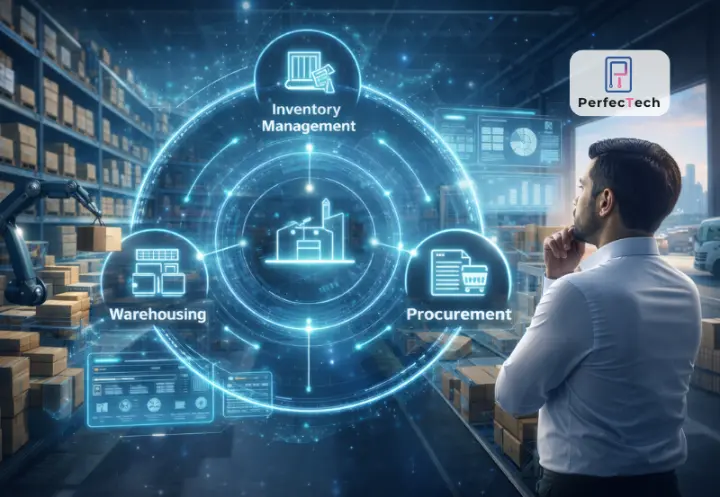
ERP connects procurement with real-time inventory levels and demand signals. Purchase decisions align with actual consumption patterns and warehouse capacity. Logistics planning becomes predictable rather than reactive.
The supply chain begins to operate as an integrated flow instead of disconnected functions.
Financial Discipline Starts Before Spend Occurs
One of the most critical advantages of ERP-driven procurement is upstream financial control.
Budget validation, cash visibility, and commitment tracking occur before purchase orders are approved. CFOs gain confidence that procurement activity aligns with financial plans and liquidity constraints.
This prevents surprises and strengthens enterprise-wide financial discipline.
Why Odoo ERP Supports Saudi Procurement Complexity
Odoo’s ERP architecture supports complex procurement environments without forcing rigid operating models.
Saudi enterprises can configure multi-warehouse operations, supplier approval rules, VAT handling, and delegated authority structures within a single system. As procurement scale increases, the system evolves without disruptive replacement.
This flexibility allows procurement governance to mature alongside business growth.
Digital Procurement Is an Architectural Decision, Not a Software Choice
Many procurement initiatives fail because they focus on digitizing existing processes instead of redesigning control structures.
True digital procurement requires alignment between procurement policy, supply chain design, and financial governance. ERP provides the architectural foundation that makes this alignment operational.
Without architecture, automation only accelerates fragmentation.
Why Saudi Enterprises Work with Perfect Tech
Perfect Tech approaches procurement ERP as a governance and control initiative, not a technology rollout.
By designing ERP architectures that reflect Saudi operational realities, regulatory requirements, and enterprise scale, Perfect Tech enables procurement to become a source of resilience rather than risk.
Procurement Architecture Determines Supply Chain Resilience
In an environment defined by volatility and scale, procurement discipline determines supply chain stability.
For Saudi enterprises, ERP-driven procurement architecture provides the visibility, control, and speed required to grow without eroding margins or operational reliability. Digital procurement is no longer optional—it is essential infrastructure.
(FAQ)
At what point does procurement complexity become a governance risk?
Procurement becomes a governance risk when leadership cannot explain spend behavior, supplier exposure, or inventory imbalance without manual investigation. At that stage, fragmentation is already impacting control.
How can enterprises enforce procurement discipline without slowing operations?
By embedding approval logic, budget checks, and supplier rules into ERP workflows so control happens automatically, not through manual oversight.
What hidden risks typically exist in decentralized procurement models?
Common risks include supplier dependency, off-contract purchasing, uncontrolled spend, delayed VAT exposure, and inventory distortion.
How does ERP improve supply chain resilience during disruption?
ERP provides real-time visibility across suppliers, inventory, and logistics, enabling faster response and informed decision-making during disruption.
Why is procurement ERP an architectural decision rather than a tool selection?
Because governance depends on how systems, policies, and financial controls are designed together. Software alone cannot resolve structural fragmentation.
Digital Procurement & Supply Chain ERP for Saudi Enterprises