Odoo Manufacturing ERP for Saudi Industrial Enterprises
The Operational Control Gap in Expanding Saudi Manufacturing Groups; as Saudi manufacturing enterprises scale production capacity, expand across plants, and integrate regional supply chains, operational control often becomes fragmented. Production planning, inventory, quality, maintenance, and finance operate in parallel systems, limiting executive visibility and increasing cost, waste, and delivery risk. Modern ERP architecture resolves this fragmentation by unifying manufacturing operations, supply chain, quality, and financial governance into a single industrial backbone. For CEOs, COOs, and plant directors, manufacturing ERP is no longer a production system—it is critical infrastructure for margin protection, operational resilience, and scalable growth.
When Manufacturing Complexity Exceeds Human Coordination
In early growth stages, manufacturing operations rely heavily on experienced supervisors, manual scheduling, and localized decision-making. As Saudi manufacturers expand into multi-plant or multi-country operations, this model reaches its limits.
Production plans conflict with material availability. Inventory buffers grow to compensate for uncertainty. Quality issues surface late. Management relies on lagging reports rather than real-time insight.
At enterprise scale, operational inefficiency is not a skills issue. It is a systems issue.
Why Fragmented Manufacturing Systems Destroy Margins
Many industrial enterprises manage production, inventory, maintenance, and quality in disconnected systems. Each function optimizes locally without alignment to enterprise goals.
This fragmentation creates hidden losses. Excess inventory masks planning errors. Downtime increases due to poor maintenance visibility. Scrap and rework erode margins quietly. Finance reconciles production costs after losses are already realized.
Margin erosion rarely appears suddenly. It accumulates through systemic fragmentation.
ERP as the Industrial Operating System
Manufacturing ERP transforms operations by embedding governance directly into production execution.
Demand planning, material requirements, production orders, quality checks, maintenance, and costing operate within one system. Decisions are validated against capacity, material availability, and financial impact before execution.
ERP turns manufacturing from reactive adjustment into controlled industrial execution.
Production Planning Grounded in Real Constraints
Advanced ERP planning aligns demand forecasts with actual machine capacity, labor availability, and material supply.
Saudi manufacturers gain realistic production schedules rather than optimistic targets. Bottlenecks are visible early. Planning decisions reflect operational reality, not assumptions.
Execution stability improves across plants.
Inventory and Cost Control as Strategic Levers
Manufacturing profitability depends on inventory discipline and accurate costing.
ERP provides real-time visibility into raw materials, work-in-progress, and finished goods. Cost accumulation is tracked continuously across production stages. Management gains clarity on true product margins.
Inventory shifts from a buffer to a managed asset.
Quality and Compliance Embedded in Operations
Industrial quality and regulatory compliance cannot be managed after production.
ERP embeds quality checkpoints, traceability, and compliance documentation directly into production workflows.
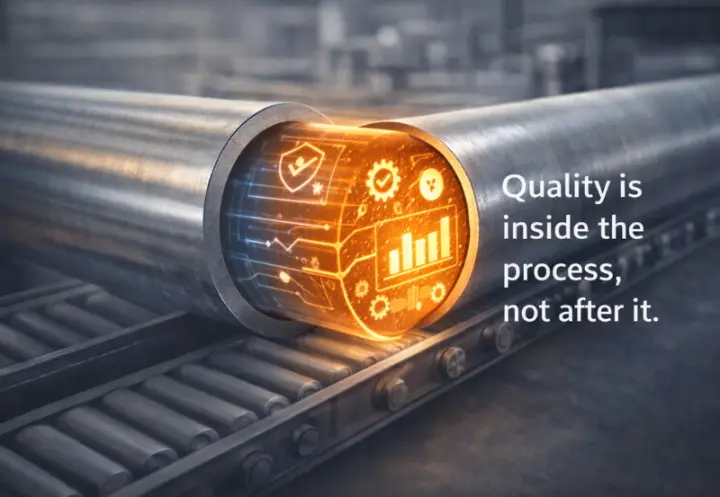
Defects are identified early. Audit readiness becomes continuous rather than episodic.
Quality becomes a system outcome, not an inspection activity.
Maintenance as a Production Reliability Function
Unplanned downtime is one of the most expensive risks in manufacturing.
ERP integrates maintenance planning with production schedules and asset performance data. Preventive maintenance is enforced automatically. Failure patterns are identified before they disrupt operations.
Plant reliability improves without over-maintenance.
Why Odoo ERP Fits Saudi Manufacturing Environments
Odoo’s ERP architecture supports diverse manufacturing models, from discrete and process manufacturing to mixed-mode operations.
Saudi industrial enterprises can configure multi-plant operations, localization requirements, costing models, and quality processes within a single scalable system. As production complexity grows, the ERP architecture adapts without disruption.
This flexibility is essential for manufacturers operating under rapid expansion and Vision 2030 initiatives.
Manufacturing ERP Is an Architectural Decision, Not a Production Tool
Many manufacturers attempt optimization through isolated MES or planning tools. While useful locally, these tools do not provide enterprise control.
True manufacturing excellence requires architectural alignment between production, supply chain, quality, maintenance, and finance. ERP provides the backbone that unifies these dimensions.
Without architecture, optimization remains fragmented.
Why Saudi Manufacturers Partner with Perfect Tech
Perfect Tech approaches manufacturing ERP as an industrial governance initiative.
By designing ERP architectures aligned with Saudi manufacturing realities, regulatory requirements, and scale ambitions, Perfect Tech enables manufacturers to grow without sacrificing margins or control.
Final Perspective: Manufacturing Control Determines Industrial Competitiveness
In competitive industrial markets, success depends on disciplined execution and visibility.
For Saudi manufacturers, ERP-driven industrial architecture provides the control, resilience, and insight required to scale confidently. Manufacturing ERP is not optional—it is foundational infrastructure.
(FAQ)
At what point does manufacturing complexity become a governance risk?
When leadership cannot explain cost variance, downtime, or inventory exposure without manual investigation, manufacturing complexity has already exceeded control capacity.
How can manufacturers improve margins without increasing capacity?
By using ERP to expose hidden losses in planning, inventory, downtime, and rework, enabling optimization within existing assets.
What hidden risks exist in fragmented manufacturing environments?
Common risks include inaccurate costing, excess inventory, quality escapes, unplanned downtime, and delayed regulatory compliance.
How does ERP support multi-plant manufacturing operations?
ERP provides centralized planning, costing, and governance while allowing local execution flexibility at plant level.
Why is manufacturing ERP an architectural decision rather than a system upgrade?
Because industrial performance depends on how production, quality, maintenance, and finance are structurally connected. Tools alone cannot provide enterprise control.
Odoo Manufacturing ERP for Saudi Industrial Enterprises